|
X1 ELECTRIC CAR
|
||||||||
|
HOME | AUTOMOTIVE | BLUEPLANET | ELECTRIC CARS | FORMULA E | ENERGY | INSURANCE | INDEX | SOLAR CARS |
||||||||
|
May 5 2005 - Silicon Valley's big brains think they can beat Detroit and Tokyo and save the planet - all while doing 0 to 60 faster than almost anything on the road.
SAN FRANCISCO - Ian Wright has a car that blows away a Ferrari 360 Spider and a Porsche Carrera GT in drag races, and whose 0-to-60 acceleration time ranks it among the fastest production autos in the world. In fact, it's second only to the French-made Bugatti Veyron, a 1,000-horsepower, 16-cylinder beast that hits 60 mph half a second faster and goes for $1.25 million.
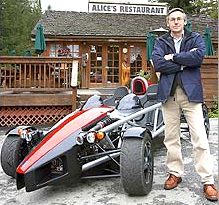
Ian Wright previously designed routers and switches for Digital Equipment and Cisco
The key difference? The Bugatti gets eight miles per gallon. Wright's car? It runs off an electric battery.
Wright, a 50-year-old entrepreneur from New Zealand, thinks his electric car, the X1, can soon be made into a small-production roadster that car fanatics and weekend warriors will happily take home for about $100,000 - a quarter ton of batteries included. He has even launched a startup, called Wrightspeed, to custom-make and sell the cars.
But Wright isn't some quixotic loner. He's part of a growing cluster of engineers, startups, and investors, most of them based in Silicon Valley, that believe they can do what major automakers have failed at for decades: Think beyond the golf cart and deliver an electric vehicle (EV) to the mass market.
Indeed, the race for the new consumer EV has already begun: Just a year ago, Wright was working for his Woodside neighbor Martin Eberhard, co-founder of Tesla Motors, a startup that has 70 employees and a major investment from PayPal founder Elon Musk, which is building a mass-market rival to the X1. Wright left, believing he had an even better idea.
Beyond that, startups are forming to equip new "plug-in" hybrids that run almost entirely on their electric motors. And around the country, a handful of other exotic EVs are showing up on the road -- including George Clooney's new ride, a $108,000 commuter coupe that's just 3 feet wide.
The more that cars become technology platforms, the more the future plays into the hands of people like Wright and Eberhard. "Automakers can't do this," Eberhard says. "If you drill into the complexity of an electric car, it's not the motor, it's the electronics and battery system, which car companies aren't good at."
Adds Musk, "The time is right for a new American car company, and the time is right for electric vehicles, because of advances in batteries and electronics. Where's the skill set for that? In the Valley, not Detroit."
Wright's garage-born heroics are, in many respects, long overdue. After all, electric cars predated the gasoline combustion engine. But they soon headed for museums, replaced by gas engines. A mid-1990s wave of all-electric cars was short-lived -- GM (Research) spent more than $1 billion to introduce a short-lived electric vehicle -- and were soon replaced by Toyota's hot-selling hybrid gas-electric Prius.
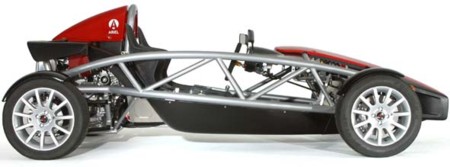
So how do you build the EV of the future on a six-figure budget when GM couldn't do it with more than $1 billion? For starters, you get all the basic parts off the shelf, starting with a chassis. Wright found one he liked in the Ariel Atom, a blazing-fast custom British roadster. By itself, all the hardware in the X1 is nothing new. The X1's real secret is how Wright engineers it all to keep the car in optimum race mode whenever you hit the accelerator.
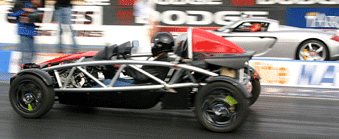
The X1 recently beat a Ferrari 360 Spyder at the Infineon Raceway in northern California
Proving grounds
Last November, Wright towed the X1 to a racetrack near Sacramento to see how his prototype would do against a Ferrari and a Porsche. On paper, a win seemed guaranteed. But he hadn't yet run the car full out.
In the first matchup, the X1 crushed the Ferrari in an eighth-mile sprint and then in the quarter-mile, winning by two car lengths. In the second race, against the $440,000 Porsche, the two cars were even after an eighth of a mile. But as the Porsche driver let out the clutch in a final upshift, his tires briefly lost traction. The X1, blazing along in its software-controlled performance mode, beat the Porsche by half a car length.
It never occurred to me that I would lose," says Kim Stuart, the Porsche's driver. "It was like a light switch. He hit the pedal and was gone."
So what now? Wright isn't sure himself. Only 50 or so people have driven the car, and Wright has just begun to hold his hat out for potential investors. With $8 million in funding, he says, he is convinced he can put a consumer version of the X1 into production that meets federal safety standards, has a 100-mile range, and recharges in 4.5 hours.
To bring any EV to the masses, of course, will require much improved battery technology. But a handful of startups backed by Valley VCs are claiming that big advances are just around the corner. Menlo Park-based Li-on Cells claims that its technology will double the performance of lithium-ion batteries for about half the cost.
Thus, the X1 and the Tesla could be just the things to throw the EV race into high gear. As battery prices drop and performance improves, the cars could come within reach of a wider audience. And if oil prices keep climbing, more and more consumers will demand alternatives that are punchier than a Prius.
The X1
The Wrightspeed X1 uses Lithium-ion batteries and a high-power electric motor to give three major benefits:
Wright is a 50 year old New Zealand native who's electric car the X1 is about to be made into a small production roadster that gear heads and thrill seekers will be able to take home for about $100,000. Wright has started a company, Wrightspeed, in Silicon Valley to custom make and sell the cars. The key Wright says to being successful and keeping cost down is his cars ability to use off the shelf parts for almost all aspects of the X1, even the quarter ton of batteries the car uses.
In the first race the X1 beat a Ferrari 360 Spyder in both an 1/8 mile and 1/4 mile race winning the later by two car lengths. The second race against Germany's fastest street car the Porsche Carrera GT was a little closer with the X1 only winning by a half of car length. The driver of the Porsche Kim Stuart said "It never occurred to me that I would lose. It was like a light switch. He hit the pedal and was gone."
Whats next for Wright and the X1? Currently he's starting to look for investors and he's convinced that a production version of the X1 can be produced that will meet federal safety standards, has a 100-mile range and will recharge in just 4.5 hours. But key to the success of the X1 and for that matter any electric vehicle is continued improvement of battery technologies that will yield higher mileages, quicker recharge times, and better battery life.
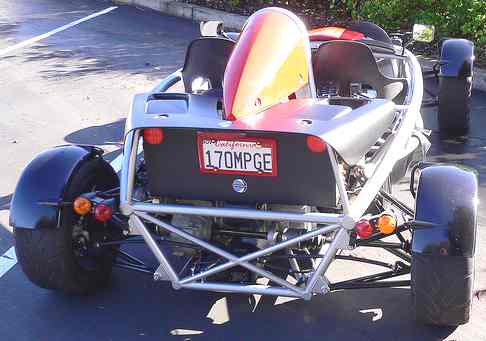
X1 electric prototype suspension detail
X1 Prototype Specs
Ian Wright (a former Cisco engineer) built the X1which blew away a Ferrari 360 Spider and a Porsche Carrera GT in a drag race! With a 0 to 60 time of 3 seconds it can only be bested by the $1.25 million dollar Bugatti Veyron and it's 1000-horsepower, 16 cylinder engine (it's a half second faster).
Please click on the links above to find out about these famous automotive makers. If your company is not included and you would like to be listed, please let us know.
UK VEHICLE INSURANCE ONLINE A - Z
A taste for adventure capitalists
The world's fastest electric car: 350mph + using energy from nature. Featuring built in battery cartridge exchange, charged using renewable solar energy. Sponsors sought for the 2016 season.
|
||||||||
|
BLUEPLANET BE3 ELECTRIC | EDUCATION | ELECTRIC CYCLES | SOLARNAVIGATOR |
||||||||
|
The
content of this website is copyright © 1991 and 2013 Electrick
Publications. All rights reserved. The bluebird logo |
||||||||