|
MILK FLOAT RECORD - 27 August 2003
|
||||||||||||||||||
|
HOME | AUTOMOTIVE | BLUEPLANET | ELECTRIC CARS | ENERGY | INSURANCE | INDEX | SOLAR CARS |
||||||||||||||||||
|
Two teams met at Bruntingthorpe Aerodrome in Leicestershire on 27th August 2003 for a competition to set the first World Milk Float Land Speed Record.
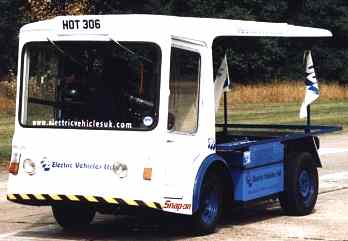
CBL Electric Vehicles of Bampton, Oxfordshire, were the brains behind the Electric Dream Team, led by driver Daniel Hoffmann-Gill from Nottingham. Their vehicle was a Morrison Electricar dating from the 1950s, with a much altered driveline and control equipment, extra cell packs and safety equipment.
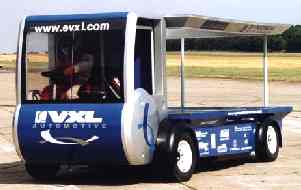
The opposition was EV engineering firm VXL Automotive, a subsidiary of Symonds Hydroclean, based near Newport, Gwent. Their entry was a development vehicle for their latest model, the Electron E150. It is powered by a 12000rpm AC motor and features an exchange battery pack system similar to that pioneered by General Motors, Lucas and other van companies in the 60's and 70's.
Design consultancy was provided by Bluebird Automotive Group Ltd of Swansea, a company formed by the directors of Bluebird Technologies Limited (Co. No. 03469526) Martin Rees and David Hammond-Williams, to take over from 'BTL', that company having run into financial difficulties.
VXL Automotive Milk Float
The VXL Automotive team brought the modern quiet float to challenge Dan's team for the record. Although this is a development vehicle not fitted for road use, production vehicles are already being built for several customers and are likely to appear in service soon. The float is seen approaching the end of its return run, driven by Richard Rozhon.
HOT 306 was the contender for the CBL Electric Dream Team. Apart from the rear axle and internal cab structural reinforcements (for safety reasons), the vehicle retains the appearance of a standard Morrison float. It is licenced for road use, and the registration number is genuine.
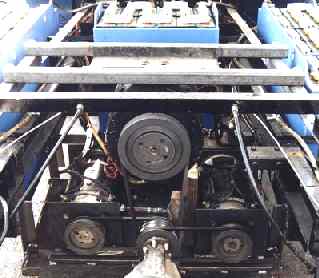
The CBL 'Morrison' Milk Float conversion featuring 3 motors - With thanks to Dave Root for photos
Under the platform, things are very different, as the picture above shows. Twin DC motors are provided to start and accelerate the float, whilst the larger DC motor above (a standard float motor) is cut in once a certain speed is reached. The motors are connected to the drive-shaft via a system of pulleys and rubber belts. An extra battery pack can be seen centre front, whilst another is located at the rear below the camera position.
The winner was the VXL float with a recorded average speed of 73.39mph; the CBL float managed an average of just 47.61mph, although the maximum recorded was around 52mph. It had, in fact, achieved higher speeds on test, but most unfortunately had caught fire a few days before the event, and had not been quite the same since. The belts driving the pulleys also proved troublesome, with noticeable slipping taking place.
CBL's engineers appeared keen to beat VXL's record in the future, and intend to use HOT 306 again for the purpose. For their part, VXL believe their float should be capable of 100mph, so it is entirely possible that this event may be repeated at a future date. Links to news articles about the event:
Other Modified Floats
The race held at Bruntingthorpe was not the first time milk floats have travelled at high speed, although previous attempts have all resorted to alternative means of propulsion, such as a petrol engine or even a jet engine!
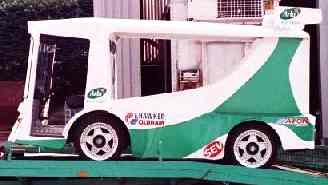
Another Arla Morrison Milk Float conversion
This Arla Morrison float has been cosmetically modified to resemble a racing vehicle, presumably for promotional purposes, although in reality it retains its normal driveline.
NEW FOR 2012
Check out the latest electric milk floats from China, being imported by:
EV Innovations Limited Company Registration Number 07918747
COMPANIES HOUSE WEBCHECK
ANTI-COUNTERFEITING TRADE AGREEMENT (ACTA)
BLUE BIRD TRADEMARK LOGO
The registered trade mark seen at the foot of this page has not been licensed to anyone for use on road going electric vehicle, except to the designer of the BE3, for his electric vehicles. Please keep a look out for vehicles such as Milk Floats and Racing Cars that bear a bird logo of a blue colour. If you notice any vehicles adorned with a blue bird logo that is from another manufacturer, please contact the Intellectual Property Office and register your concerns. If you could also copy us in on any such notification, that would be much appreciated:
Email:
LATEST NEWS
A taste for adventure capitalists
The world's fastest solar powered electric car: 350mph + batteries charged using energy from nature
|
||||||||||||||||||
|
BLUEPLANET BE3 | EDUCATION | ELECTRIC CYCLES | SOLARNAVIGATOR |
||||||||||||||||||
|
The
content of this website is copyright © 1991 and 2013 Electrick
Publications. All rights reserved. The bluebird logo |
||||||||||||||||||