|
GRAND PRIX HISTORY
|
|||||||
|
Grand Prix motor racing has its roots in organized automobile racing that began in France as far back as 1894. It quickly evolved from a simple road race from one town to the next, to endurance tests for car and driver. Innovation and the drive of competition soon saw speeds exceeding 100 mph but because the races were held on open roads there were frequent accidents with the resulting fatalities of both drivers and spectators.
The drivers in Formula One race in Grands Prix (French for Big Prizes) which count towards the Formula One World Championship. The minimum distance of a Grand Prix is 305 km, but no race can last for more than two hours.
The first event to have been planned was to have been a short trial in Paris organized by "Le Velocipede" in 1887, but only one competitor turned up and so it was abandoned. The first organized event was actually a Reliability Trial run from Paris to Rouen in 1894 over a distance of 126 km. It was organized by a newspaper, Le Petite Journal, and the winning "horseless carriage" had to be "safe, easily controllable and reasonably economical to run."
Organized racing
A seminal event in racing came in 1900 when James Gordon Bennett, Jr. (1841-1918), the owner of the New York Herald newspaper and the International Herald Tribune in Paris, France, established the Gordon Bennett Cup in Europe, an annual race that attracted international competitors. Each country was allowed to enter up to three cars. Following Bennett's lead, in the United States, the wealthy William Kissam Vanderbilt II launched the Vanderbilt Cup at Long Island, New York in 1904. Influenced by these racing events, Louis Chevrolet (1878-1941), a Swiss-born employee of a French motor vehicle manufacturer would move to the United States and beginning in 1910 would become a major figure in American racing and the designer of a car for General Motors that bears his name.
Twenty one entries left Paris on July 22nd, and the first home was Count de Dion in a steam driven De Dion tractor. Unfortunately for De Dion, the jury decided that his car was not a practical road vehicle and instead awarded the prize jointly to the next two leading cars, a Peugeot and a Panhard-Levassor respectively. The winning average speed was an exhilarating 17km/h. Many town races were run in the following years including Paris to Bordeaux and back. This 1895 event, a true race, was won by Emille Levassor. Driving a 2-cylinder, 4-bhp Panhard-Levassor he drove 48 hours 48 minutes virtually non-stop.
Because his car only had two seats instead of the required four he was denied the prize of 31,000 francs, yet it is his statue that overlooks the finishing line at the Porte Maillot in Paris. Another interesting entrant in this race was the Peugeot of André Michelin which used pneumatic tires. Typically wheels used on other cars were either iron or solid rubber. At first the "air tyre" was ridiculed as impractical and indeed Michelin's car suffered from numerous flats due to the poor condition of the roads at the turn of the century. Panhard would dominate racing until the end of the century. The following years saw an ever increasing search for speed and the easiest path was to increase engine size. Soon 7 and 8 liter engines were common place and even a 16 liter engine was produced.
Developments in chassis design, brakes and tires did not maintain pace but in 1901 that changed with the introduction of the 35 h.p. Mercedes. It was the first sports-racing car which featured a four cylinder engine with mechanical valves, a "honeycomb" radiator, a steel chassis, pneumatic tires and a magneto ignition. After solving some early reliability problems and coupled with the increase of engine capacity to 9 liters producing 60 h.p., the car became a consistent race winner. Each of the leading manufactures contributed advancements to automobile design. Renault produced a car with shaft drive and a live rear axle. A superb example of this Mercedes is on display at Filching Manor Motor Museum in Sussex, England.
The first Grands Prix
In 1906 the first (and at that time only) race carrying the name Grand Prix was organized by the Automobile Club de France (ACF), and run over two days in June. The Le Mans based circuit used was roughly triangular in shape, each lap covering 105km (65 miles). Six laps were to be run each day, and each lap took about an hour using the relatively primitive cars of the day. From the 32 entries representing 12 different automobile manufacturers, the Hungarian-born Ferenc Szisz (1873-1944) won the 1260 km race in a Renault.
Races in this period were heavily nationalistic affairs, with a few countries setting up races of their own, but no formal championship tying them together. The rules varied from country to country and race to race, and typically centered around maximum (not minimum) weights in an effort to limit power by limiting engine size indirectly (10-15 liter engines were quite common, usually with no more than four cylinders, and producing less than 50hp). The cars all had mechanics on board as well as the driver, and no one was allowed to work on the cars during the race except these two. A key factor to Renault winning this first Grand Prix was held to be the detachable wheel rims, which allowed tire changes to occur without having to lever the tire and tube off and back on the rim. Given the state of the roads, such repairs were frequent.
Nation shall race against Nation
The Automobile Club de France, which was formed in 1895, decided after many disagreements over regulations to hold their own races. In 1906 The French held the very first Grand Prix for manufactures over a 64-mile course near Le Mans. Of the 32 cars that started the race 11 remained after 12 laps split over two days. The winner was Ferenc Szisz, a Hungarian, driving a 90hp Renault. His Renault utilized detachable rims created by Michelin which enabled him to change tires in 2 to 3 minutes instead of the normal 15 minutes. Another important event that year was the inaugural Targa Florio. Organized by the wealthy Sicilian Vicenzo Floria, the race covered three laps of 148.832 km over mountain roads unchanged since the Punic Wars.
In 1907 the Germans held their own race, the Kaiserpreis, for touring cars of under 8 liters and weighing less than 1165 kg. The race was won by Nazzaro in a Fiat. France, the birthplace of auto racing was finding itself among the also rans. After dominating racing up until 1906 they were supplanted by the Alfa of Italy and Mercedes of Germany. The defining race of the pre- WW1 era was the ACF Grand Prix of 1914. The race was held on a 36.63 km circuit near Lyons and would last 20 laps. The formula for that year restricted engine capacity to 4500cc and weight to 1100kg. Peugeot, determined to return France to the front ranks of motor sports entered three cars that featured four-wheel brakes.
The main challenge for France were the Germans led by five Mercedes. With the political tensions in Europe coming to a head the race could not escape from having political overtones. Max Sailor, a Mercedes director and race car driver led from the start with the Peugeot of Georges Boillot in second. The leading Mercedes developed engine trouble and on the sixth lap the Peugeot took the lead. The French crowd erupted into patriotic demonstrations. The order was now Peugeot, the Mercedes of Lautenschlager, another Peugeot and the Mercedes of Wagner.
It was now Wagner's turn to make a charge and on the 11th lap he forced his way into second. The second Peugeot, driven by Goux began to overheat and was destined to retire. This left the Peugeot of Boillot still in from ahead of the on coming Germans. The 15th lap had now been completed with the Peugeot 2 minutes and 28 seconds ahead of the Mercedes driven by Wagner. After running a conservative race in the early laps Lautenschlager was now poised to begin his march. Passing his teammate he began to close the gap on the leading Peugeot. Boillot drove for all he was worth but nothing could stop the Mercedes from taking the lead. The Peugeot, not able to withstand the strain broke a valve and retired. Mercedes now owned the first three places and so they finished with Lautenschlager claiming his second ACF Grand Prix title. The sullen crowd responded with only a smattering of applause while the Mercedes pits erupted in joy. On this bitter note, for France, racing stopped on the European continent. Several leading drivers without a European outlet crossed the Atlantic and entered the Vanderbilt Cup, Indianapolis and the American Grand Prize.
The rise of purpose built racing circuits
1925 saw a number of developments. New road racing circuits were being built throughout Europe including Miramas, near Marseilles and Spa-Francorchamps in Belgium. Riding mechanics were banned as they had been in America. The first World Championship was organized and included the French, Italian and Belgian Grand Prix and the Indianapolis 500. This championship was between manufactures rather than drivers. Alfa Romeo won that inaugural year and celebrated the victory by incorporating a laurel wreath into its badge. Unfortunately this also marked the high point for Grand Prix racing until the next decade. Because of escalating costs and few perceived benefits most of the major manufactures decided to abandon their factory racing efforts.
One event that stood out during this period was the Mille Miglia. The Mille Miglia was designed as a way to promote and improve Italian motor car design and reliability. Improving Italian roads was unfortunately not a priority as a recent visit to that country can attest.
The
Mille Miglia provided a test of almost 1000 grueling miles of good, bad,
and indifferent roads. The route traveled east to Vicenza, south along the
Adriatic to Pescara, west to Rome and then northwest to Brescia. It was
the province of Italian drivers for most of its history. Traditionally the
first cars, the amateurs, would leave Brescia at 9 p.m. at 1-minute
intervals and return 16-24 hours later.
Hundreds of thousand of spectators would line the roads to cheer their heroes on. In fact it was a lack of crowd control that would actually cause this race to be abandoned after the 1957 race which saw the death of the Marquis de Portago, his co-driver and ten spectators. This race has played host to many epic drives such as that undertaken by Caracciola in 1931 and Moss/Jenkinson in 1955. But none could top the Mille Miglia of 1930 when Nuvolari racing through the night, passed Varzi with his headlights turned off! In three weeks Varzi returned the favor by coming back from a car fire to win the Targa Florio.
Racecourse development
For the most part, races were run over a lengthy circuit of closed public roads, not purpose-built private tracks. This was true of the Le Mans circuit of the 1906 Grand Prix, as well as the Targa Florio (run on 93 miles of Sicilian roads), the German Kaiserpreis circuit (75 miles long), and the French circuit at Dieppe (a mere 48 miles), used for the 1907 Grand Prix. The exceptions were the steeply banked egg-shaped near oval of Brooklands in England, completed in 1907, the Indianapolis Motor Speedway, first used in 1911, and the Autodromo Nazionale Monza, in Italy, opened in 1922.
In 1922, Italy became the first country outside France to host a race using the name Grand Prix, run at Monza. This was quickly followed by Belgium and Spain (in 1924), and later spread to other countries. Strictly speaking, this still wasn't a formal championship, but a loose collection of races run to various rules. (A "formula" of rules had appeared just before World War I, finally based on engine size as well as weight, but it wasn't universally adopted.) In 1924, however, many national motor clubs banded together to form the Association Internationale des Automobile Clubs Reconnus (AIACR), whose Commission Sportive Internationale (CSI) was empowered to regulate Grand Prix and other forms of international racing. Since the inception of Grand Prix racing, competitions had been run in accordance with a strict formula based on engine size and vehicle weight. These regulations were virtually abandoned in 1928 with an era know as "Formula Libre" when race organisers decided to run their events with almost no limitations. From 1927 to 1934, the number of races considered to have Grand Prix status exploded, jumping from five events in 1927 to nine events in 1929 to eighteen in 1934 (the peak pre-World War II year).
The Pre-WW II years
Important individual and corporate names emerged during this time who would change the face of automobile design and engineering: The 1933 Monaco Grand Prix was the first time in the history of the sport that the grid was deciding by timed qualifying rather than the luck of a draw. All the competing vehicles were painted in national colors: blue for the French drivers, green for the British, red for the Italian, yellow for the Belgians, and white for the Germans. Beginning in 1934, the Germans stopped painting their cars, after the paint had been left off a Mercedes-Benz in an effort to reduce weight. The unpainted metal soon had the German vehicles dubbed by the media as the "Silver Arrows".
French cars continued to dominate (led by Bugatti, but also including Delage and Delahaye) until the late 1920s, when the Italians (Alfa Romeo and Maserati) began to beat the French cars regularly. At the time, the Germans engineered unique race vehicles as seen in the photo here with the Benz aerodynamic "teardrop" body introduced at the 1923 European Grand Prix at Monza. In the 1930s, however, nationalism entered a new phase when the Nazis encouraged Mercedes and Auto Union to further the glory of the Reich. (The government did provide some money to the two manufacturers, but the extent of the aid into their hands was exaggerated in the media; government subsidies amounted to only about 10% of the costs of running the two racing teams.) The two German marques utterly dominated the period from 1934 to 1939, winning all but three of the races run in those years. The cars by this time were single-seaters (the riding mechanic vanished in the early 1920s), with 8 to 16 cylinder supercharged engines producing upwards of 600hp on alcohol fuels.
As early as October of 1923 the idea of an automobile championship was discussed at the annual fall conference of the AIACR (Association Internationale des Automobile Clubs Reconnus) in Paris. However, discussion centered around the increased interest in racing by manufacturers and holding the first European Grand Prix at Monza in 1923. The first World Championship took place in 1925 but was for manufacturers only, consisting of four races of at least 800 km in length. The races that formed the first Constructors Championship were the Indianapolis 500, the European Grand Prix, and the French and Italian Grands Prix. A European Championship, consisting of the major Grand Prix in a number of countries (named Grandes Epreuves) was instituted for drivers in 1935, and was competed every year until the outbreak of World War II in 1939.
Auto Union a amalgamation of four firms - Horch, Audi, Wanderer and DKW - chose a more radical concept for their Type A Grand Prix car. Designed by Dr. Ferdinand Porsche, the mid-engined car placed the driver lower and further towards the front. It had a V16 4.4-litre supercharged engine that ran on special fuels mixed to a very secret formulae. The exhaust fumes that poured out by the engines was so strong that bystanders would complain of nausea and headaches! The Auto Union like the Mercedes used 4-wheel independent suspension. The suspension was later changed to a De Dion system in the Mercedes to improve handling over bumps and high-speed corners. Both cars were expected to make their debut at Avus near Berlin. During practice the Mercedes all suffered from carburetor problems and were forced to pull out. A parade of the three Auto Union race cars before 200,000 German spectators proved to be the highlight for the German team as only one car was left to finish third behind the Alfas of Guy Moll and Chiron! Two weeks later the German cars tasted their first blood.
The
Eifelrennen held at the Nurburgring, saw the German cars finished 1-2 with
the Mercedes of von Brauchitsch leading the Auto Union of Stuck. Prior to
the beginning of the race the Mercedes team created a little excitement
when it was found that their cars were 1 kg over the weight limit.
Following a suggestion by von Brauchitsch, Alfred
Neubauer had the paint from each car removed in order to meet the
weight limit, leaving the polished aluminum of the cars exposed and so
began the legend of the "Silver Arrows".
In 1935 both Mercedes and Auto Union continued to develop their cars with Auto Union replacing the rear leaf springs with a torsion-bar suspension. Both had their engines enlarged, the Auto Union now at 4950cc/375bhp while the Mercedes was at 3990cc/430bhp. Alfa Romeo made one valiant attempt to stop the German assault that resulted in a two-engined gas sucking 540bhp car known as the Bimotore. Built by Scuderia Ferrari in Modena this car was intended for fast tracks such as Avus. Interestingly both engines drove the rear wheels. But its high tire wear and prodigious gas consumption proved its Achilles heal. A European Championship for drivers was introduced and was promptly claimed by Rudolf Caracciola after victories in Belgium, Switzerland and Spain. Rudolf Caracciola would go on to win the title again in 1937 and 1938 while Bernd Rosemeyer would triumph in 1936. The German cars dominated Grand Prix Racing and except for remarkable victories by great drivers such as Chiron and Nuvolari the Italian and French cars had to console themselves with the 1.5-liter voiturette class. One such victory was the German Grand Prix of 1935.
The Greatest Victory of all time
1936
was the year of the Auto Union Type C driven by Bernd Rosemeyer. The
engine had been enlarged again to 6006cc and produced an astounding 520
bhp.
Tragically, before the beginning of the 1938 season, the heart of the Auto Union team was torn out by the death of its star. Bernd Rosemeyer died while attempting a speed record on the Frankfurt-Darmstadt autobahn. The Auto Union team even with the talents of Nuvolari was never the same again. The AIACR instituted a new formulae which limited engine size to 3 liters supercharged or 4.5 liters unsupercharged. Mercedes and Auto Union answered this new challenge without pause and continued their dominance. Alfa Romeo abandoned the formula and concentrated on the 1.5-litre voiturette class for their entry in the Tripoli Grand Prix of 1939. Unbeknownst to Alfa, Mercedes secretly prepared two 1.5-litre W165 cars for Herman Lang and Caracciola and promptly finished 1-2. Only the outbreak of the Second World War would stop the German juggernaut. The cars of this era have rightly been considered some of the greatest racing cars ever produced by man.
There were only four races of Grand Prix caliber held during 1946. The top drivers included Giuseppe 'Nino' Farina, Jean-Pierre Wimille, Louis Chiron, Achille Varzi and Tazio Nuvolari. The Fédération Internationale d'Automobiles (FIA) was formed to organize the sport at an international level. A formula was set for 1947 that allowed 1.5-litre supercharged or 4.5-litre unsupercharged cars. Alfa Romeo would win every race that it entered that year. In 1948 Ferrari fielded their own car, after parting with Alfa before the war Enzo Ferrari promised that Scuderia Ferrari would not compete against their former patrons for four years. 1948 also saw the death of the venerable Achille Varzi while practicing for the Swiss Grand Prix. In 1949 Alfa Romeo was forced to withdraw from racing due to financial woes. Without the Alfa the field was left open to Maserati, Ferrari and Talbot to enjoy some success.
When he reached Maranello his appearance shocked Enzo Ferrari, who begged him to quit even at the cost of denying Ferrari his first victory. Some thought that he was on a suicide mission to die at the wheel of a race car rather than in a hospital. Finally the brakes on his car failed while still leading the race. He had driven the Ferrari as fast as he could, as long as he could and had it not failed nothing on this earth could have taken this last great victory from his grasp. His race over he stopped his car by the side of the road, exhausted he was lifted from his car by a local priest and put to bed. This turned out to be his last major race and five years later he was to die in bed. This man of small physical stature had the heart of a giant. Those who competed with him on the tracks of Europe knew that they would not see his likes again. The Italian nation and the world of motorsports mourned the death of the greatest driver the world would ever see.
The Post-War years and Formula One
In 1946, following World War II, there were only four races of Grand Prix caliber held. Rules for a Grand Prix World Championship had been laid out before World War II, but it took several years afterward until 1947 when the old AIACR reorganized itself as the F餩ration Internationale de l'Automobile or "FIA" for short. Headquartered in Paris, France, at the end of the 1949 season it announced that for 1950 they would be linking several national Grands Prix to create Formula One with a World Championship for drivers, although due to economic difficulties the years 1952 and 1953 were actually competed in Formula Two cars. A points system was established and a total of seven races were granted championship status including the Indianapolis 500. The first World Championship race was held on 13 May at Silverstone in the United Kingdom.
The Italians once again did well in these early World Championship races, both manufacturers and drivers. The first World Champion was Giuseppe Farina, driving an Alfa Romeo. Ferrari appeared at the second World Championship race, in Monaco, and has the distinction of being the only manufacturer to compete during the entire history of the sport, still competing in 2004. (Follow the History of the World Championship for Drivers link for more history after 1950.)
This brought the championship to the German Grand Prix at the Nurburgring. It was generally acknowledge by the Grand Prix Circus that this would be Fangio's last season. He was determined to finish on top.Fangio and Hawthorn qualified one-two and the race looked set for an epic battle. The Maserati of Fangio started the race on half tanks and it was incumbent on him to build a large enough margin that would allow him to pit yet retain his lead. This he started top do, blistering the track at a record pace but Hawthorn and Collins in the Ferraris had other ideas. On the twelfth lap Fangio dove into the pits. Even though everyone in the Maserati pits was prepared the pitstop cost Fangio the lead when both Collins and Hawthorn thundered past. Finally the work was done and Fangio re-entered the fray. All seamed loss as Fangio was now 45 seconds behind the leading duo and few thought that even the great Fangio could make up this difference. Fangio was one of the few as he began chopping off large chunks of the gap to the leaders. In the Ferrari pit panic took hold as they pleaded for their drivers to go ever faster. Fangio would later say that he drove faster than he ever wanted to drive again. The lap record came tumbling down and he would soon be lapping at a faster average speed than that with which he had qualified! Both Collins and Hawthorn continued to race at a furious pace. Peter Lewis, the famous British journalist said that "he (Fangio) might almost have been pulling them backwards on the end of a rope for on the twentieth lap Fangio sliced eleven seconds off their lead. Fangio caught Collins first and passed him on the inside but the Englishman returned the favor and pushed Fangio back into third." The second time Fangio drew alongside and then slowly drew away. Just the Collins was hit in the eye by a stone thrown up by the Maserati's rear wheel but was saved by his goggles. Now it was Hawthorn's turn and still Fangio came on; actually driving straight on in one corner to pass force his way past Hawthorn. They would finish three seconds apart with Collins coming in third. The victory gave Fangio an unassailable lead in what would become his fifth and final World Championship. So ended the maestro's greatest race.
The Rise of British Racing Green
The
British Grand Prix of 1957 saw a full complement of British Racing Green
including three Vanwalls driven by Moss,
The
1958 season started without one of its most famous names when Maserati
decided top call it quits. Ferrari had a new model, the 246 Dino, for
their drivers Hawthorn, Collins and the rising Italian star Luigi Musso.
Vanwall had Moss, Brooks and Stuart Lewis-Evans once again while Cooper
retained Brabham and Roy Salvadori. Beginning this season the cars were
required to use gasoline instead of alcohol or methane.
In between the first two races there was a time span of four months. During this period Moss and Fangio entered a 500km car race in Cuba. Fangio never made it to the starting grid, having been kidnapped by Cuban rebels in support of Fidel Castro who were protesting the governments decision to sponsor the race in despite the terrible economic conditions. Thankfully he was freed shortly after the conclusion of the race which was won by Moss. It is unknown if Moss ever again had this kind of unwanted help!
The Dutch Grand Prix at Zandvoort had an all British race car podium with Moss the victor in a Vanwall followed by Schell and Behra in BRMs. The next race, the Belgian Grand Prix at Spa was won by Tony Brooks who's fluid driving style seemed to compliment this circuit of broad high speed corners. The French Grand Prix saw both triumph and tragedy with Hawthorn scoring the first victory by Ferrari since 1956 and the death of Luigi Musso ending the great Italian line of succession. The race also marked the final race in Fangio's great career.
At Silverstone, Collins was good to his word when he sacrificed his own car to try to draw Moss into a duel. The strategy succeeded and moss' car soon broke. Collins went on to win and his pal Hawthorn scored some much needed points for finishing second. This friendship tragically ended when Collins lost his life chasing Tony Brooks for the lead at the Nurburgring. Brooks went on to win the race.
The championship race now had a third player Tony Brooks. The fight moved on to Portugal. Here Moss was in command but a mistake by Moss and his sense of honor conspired to give his rival, Hawthorn the 6 points he needed to stay in the lead for the championship. Moss misread a pit sign that read HAW-REC to mean HAW-REG or regular missing the fact that his rival had just scored one point for setting the lap record. The other incident concerned allegations that Hawthorn pushed his car when it stopped on the course, which would have resulted in disqualification. Moss came to his defense and the points were restored. Two years later the same fate would befall Moss but no one spoke in his defense, the world of racing has changed.
With the cancellation of the Grand Prix of Argentina the first race of the season would be Monte Carlo. Brabham inherited the lead and then the victory after the retirements of first Behra in a Ferrari and Moss in the Rob Walker Cooper. Zandvoort, the next race on the calendar, saw a surprise win by Jo Bonnier in a BRM. The was the marquee's first victory after nine seasons. Ferrari showed that they were still a force to reckon with on fast circuits by scoring a 1-2 at Reims with Brooks leading his teammate Phil Hill. The Cooper's were back in force for the British Grand Prix at Aintree where Brabham scored his second victory. His young teammate Bruce McLaren would finish third behind Stirling Moss. Ferrari, citing an Italian labor strike did not enter the race. The effect on the World Championship hopes of its driver Tony Brooks would prove fatal. The next race was the German Grand Prix which this year would be run on the banked Avus circuit. This being a horsepower track, provided Ferrari and Tony Brooks with a dominating win. Moss winless until now won the Portuguese Grand Prix and further tightened the World Championship race between Moss, Brabham and Brooks. Monza saw another victory for Moss with Brabham finishing third and once again picking up some valuable points.
There
was a three month gap to the next race, the United States Grand Prix, to
be held at Sebring
the home of the 12 hour sports car race.
By 1960 only Ferrari of the major contestants used a front-engine car. The young Cooper driver, McLaren won the opening race in Argentina. Moss in a private Lotus scored a brilliant victory, in the rain, at Monaco. The next five races were all claimed by Brabham and he was well on his way to scoring a second consecutive World Championship. Monza was won by Ferrari and the season ender, the US Grand Prix, was captured by Moss. Cooper once again won the Constructors Cup and their drivers were 1-2 in the title race with Brabham taking the crown for the second time running. This was the last year of the 2.5 liter formula that had seen so much history.
The
new formula for the 1961 season placed a minimum car weight of 450kg,
limited engine size to 1500cc and banned the use of supercharging
outright. The new rules were met with wide spread protest that these cars
would be to under powered and lose fan interests. The British teams were
most effected as they did not have a suitable engine and would be at a
disadvantage to Ferrari for the foreseeable future.The development of a
new V-8 Coventry-Climax engine was running into problems and most of the
British teams had to rely on an old four-cylinder unit.Ferrari, since
converted to the rear-engine format would have the advantage this year.
Driving for Ferrari were two Americans, Phil Hill and Richie Ginther who
were joined by the charismatic German Wolfgang von Trips.
Stirling Moss was relegated to a year old Lotus having been refused the latest factory model. Yet Moss would score the greatest victory of his career at Monaco. Moss recalls: "I'd say, without a doubt, that was my best race. I had to drive flat-out for all but about eleven of the 100 laps. And I mean flat-out. For the first few laps I was happy to pace myself, but when the others started to speed up I felt that I had to keep with the pack. I wouldn't normally have gone for the lead so soon but it seemed the right thing to do.' First Hill and then Ginther tried to force their way past. Always looking for the slightest mistake but there would be none this day. After being pressured by the three Ferraris for the entire race it was finally the last lap and Moss miraculously was still in the lead: "I thought, here we go, this is where they put their foot down and take me. From what I heard they were given signals by the Ferrari pits to "give all" but I managed to stay in front."
Moss took the checkered flag 3.6 seconds in front of Ginther who was followed by Hill and von Trips in the other Ferraris. The Ferraris would not be stopped again. Even Reims where all of the factory Ferraris would fall victim to mechanical problems, was won by a private entrant, Giancarlo Baghetti, in a Ferrari. It was only Moss's victory at Nurburgring and the death of von Trips at Monza that ruined a great season for Ferrari. The championship belonged to Phil Hill. Tony Brooks the former dental student who had battled for the championship against the likes of Hawthorn and and Moss announced his retirement. This gentle man was, next to Moss, the greatest British driver during the 1950's and only the vagaries of fate deprived him as it did his, friend and rival, from his crown.
Moss
never drove the Ferrari for he crashed and suffered career ending injuries
at the Easter Monday meeting at Goodwood. Graham
Hill in his book Graham, wrote: "I was leading the race
comfortably, with Stirling still two laps behind me, when he flew past on
the outside of a bend.
The season's opening race was at Zandvoort, Holland. The raced opened with Clark, Gurney and Graham Hill battling for the lead. Mechanical failures would remove his two protagonists leaving Hill to win his first Grand Prix and BRM only their second. At the next race in Monaco both Hill and Clark looked set to resume their fight but soon both of their cars would let them down. Bruce McLaren went on to claim the victory followed by Phil Hill in the Ferrari. The Belgian Grand Prix at Spa would be remembered as the site of Jimmy Clark's maiden victory. Ever since he began in Formula 1 it was not a question of if, but only when he would reach the top step of the podium.
The
French Grand Prix was held at Rouen in Normandy. The first three positions
on the grid were taken by Clark on the pole followed by Hill and McLaren.
The German Grand Prix at the famous Nurburgring saw Porsche determined to win the race in front of their home crowd. They did not disappoint their fans when Dan Gurney claimed pole position 3 seconds clear of Graham Hill's BRM and ten seconds faster than the previous record held by Phil Hill in a Ferrari. The front of the grid was occupied by five different carmakers - Porsche, BRM, Lotus, Lola and Cooper, the race had all of the ingredients of becoming a classic. The drivers whose names would become legends, were Gurney, Hill, Clark, Surtees and McLaren. The weather was such that would chill even the most ardent driver's heart. With several minor landslides along the 14-mile track visibility dropped to less than 100 yards or the distance a race car would travel in just over one second. The start of the race was postponed for an hour to allow flood water on the track to subside. After circulating the track on their warm-up reconnaissance lap the cars warily formed on the grid.
The crowds exceeding 350,000 even in the face of the atrocious conditions stood in silence in memory of their fallen hero, Wolfgang von Tripps. Then the flag dropped and the cars thundered away, that is all except for Clark's Lotus which stalled on the grid but miraculously was not collected by a back-marker. At the end of the first lap Gurney's silver Porsche led, much to the satisfaction of the assembled dignitaries. But by the second lap Graham Hill was able to force his way into the lead. And so it remained for this battle between three great drivers at the top of their game with never more than 5 seconds separating the first and third cars. On a day when even the slightest mistake would mean disaster not a wheel was put wrong by this trio. Surtees who had passed Gurney was 3.5 seconds behind Hill with the taste of victory in his mouth he looked for the slightest opportunity to pounce. Setting himself up to slingshot past the leader on the last lap he was more determined than ever that the day would be his. Just at the decisive moment when he would make his move they came upon a lapped car and Hill was just able to reach the line 2.5 seconds in front of the raging Surtees.
With three races left in the Championship the turning point would come in the next race at Monza. The two leaders in the title fight were first and second on the grid. Clark surged into the lead at the drop of the flag but by the time the cars came around for the completion of the first lap the BRM of Graham Hill was in the lead. The third time around the green Lotus was nowhere to be seen, that is if you were looking for it on the track rather than back at its pit. Out with a seized transmission Clark could only watch his friend and rival Hill raced to a solid win and claimed a commanding lead in the Championship. Ginther in the other BRM was able to make it 1-2 for the team from Bourne.
Porsche, despite scoring their first victory chose to withdraw from Formula 1. John Surtees was signed to drive for Ferrari while Gurney moved over to Brabham. The first race of the season was again held in Monaco. Despite quick starts by Hill and and his BRM teammate Ginther, Clark was soon in the lead. After temporarily relinquishing second place to Surtees, Hill found himself in the lead when first Surtees had to pit to change his goggles and then Clark spinning at Gasworks due to a jammed gearbox and having to retire. The next race at Spa was a Clark demonstration of superiority when he lapped the field under torrential rains. Zandvoort saw another Clark victory by a lap over his nearest rival. Clark made it a hat-trick at the French Grand Prix at Reims and four in a row at Brands Hatch. Surtees was finally able to create a momentary pause to the Clark steam-roller with a well deserved win at the Nurburgring. This was Surtees' first win of his four-wheel career.
For Monza both Ferrari and BRM had a new monocoque chassis. The Ferrari of Surtees stormed into the lead but fell victim to a broken valve spring. Clark assumed the lead but was strongly challenged by both Hill and Gurney. After both of his challengers suffered mechanical problems and were forced to retire Clark was able to coast to another victory which allowed him to capture the World Championship with three races remaining. Out of the three remaining races Clark was able to win two giving him seven victories out of ten races.
1964
looked to be another year of battle between Clark and Hill but there were
stirrings at Ferrari that they would once again be a force to reckon with.
But for the drivers of the red cars there would always be another obstacle
to overcome. Surtees explains: "At Ferrari in those days you started
with a handicap.
At
Zeltweg, Austria all three championship leaders were on the front row of
the grid and all three failed to finish with the win going to Surtees'
teammate Lorenzo Bandini. This unfortunately would be the popular
Italian's sole victory of his brief career. Monza belonged to Surtees and
Ferrari as they celebrated a very popular victory with their tifosi.
For the last year of the 1 1/2-litre Formula both Lotus and Brabham had at their disposal a Coventry Climax 32-Valve V8. Lotus also had a new monocoque Type 33 car while Brabham stuck with the proven tubular chassis. Disappointed at losing last years Championship despite winning the most races, Clark and Chapman were more determined than ever that 1965 would be different. Ferrari had their new flat-12 cylinder engine available should they need it to defend their Championship. Unfortunately for the Italian team this engine proved to be a step backward. Added to this mix was was the Honda Grand Prix car now in their second season and being driven by the Americans Richie Ginther and Ronnie Bucknum. Their V12 transverse mounted engine would soon become the class of the field. BRM added a Scot of their own, the brilliant rookie Jackie Stewart to partner Graham Hill. Cooper was no longer a front line team though their drivers Bruce McLaren and newcomer Jochen Rindt were both capable of causing some discomfort to the leading teams.
Thus the year began with South Africa holding the first race. The race was dominated by Clark in his Lotus who was followed by Surtees and Hill. Monaco was next and the race was held without Clark, who was at Indianapolis winning that year's classic in a Lotus Type 38 powered by an American Ford engine under a partnership with the American giant that would have tremendous consequences for Formula 1 in the near future. The race was won by Clark's rival Graham Hill in a BRM. Hill's victory at Monaco was his third in succession.
Clark
returned for Spa and won in the wet in front of the year's sensation,
Jackie Stewart. Clark and Stewart repeated their results at the French
Grand Prix. The British Grand Prix as well as the Dutch and German fell to
Clark's all-out assault on the record books. With only the top six races
counting Clark claimed a perfect score and his second World Championship.
Only when his Lotus suffered mechanical failure or was absent was there
any hope for the others, such was his dominance. A broken fuel pump
allowed Stewart a win in his maiden season and a engine failure allowed
Hill to come through. Clark stood head and shoulders above all others, a
natural talent that has not and may never be duplicated. The last race of
the season was held at the Autodrome Magdalena Mixhuca in Mexico City.
Always a problem for the teams due to the high altitude of the circuit it
proved to be an Advantage to Honda as they and Rinchie Ginther claimed
their first victory. Significantly this was also Goodyear's maiden
victory.
Monaco was the scene for the first race of the new formula and saw Clark on the pole. The race was won by Stewart who was followed across the line by Surtees. The next race at Spa was marred by wet conditions that caused eight cars to leave the track including a serious crash by Stewart that found him trapped in his car. Fortunately his injuries were minor and the race was won by Surtees after fighting off a charge by Rindt in his Cooper-Maserati. On the surface Surtees looked like a strong challenger for the title that year only to succumb to internal strife at Ferrari that resulted in his departure from the team. Surtees would later regret his departure from the Italian team. Brabham, after early season problems came in to his own in the middle races, scoring victories at Reims, Brands Hatch, Zandvoort and the Nurburgring. Monza saw a fluke victory by the Ferrari team and Ludovico Scarfiotti. Because of the failure by any of his challengers to garner significant points, Brabham clinched his third title. Clark would return to victory at Watkins Glen with the season closer going to Surtees, now driving a Cooper. The inaugural season of the new formula was won by Brabham more as the result of solid engineering rather than technical brilliance.
Lotus struggled in 1966 but for the coming year they were able to persuade Ford to invest in a brand new engine, built by the British firm Cosworth, that would come to dominate Formula 1. In initial trials with the new engine Clark required additional bracing placed behind his seat to support his head under acceleration. If that were not enough Chapman signed former World Champion Graham Hill to partner Clark in a new "super" team. Hill had been with BRM for seven years and in his own words felt that he better move on "in case they painted me over." Stewart became number one at BRM joined at different points of the season by Mike Spence, Richard Attwood, Chris Irwin and Piers Courage. Ferrari would have New Zealander Chris Amon joining Bandini full-time while Rindt was joined by Pedro Rodriguez at Cooper. Brabham continued with himself and Denny Hulme doing the driving. Honda was surprisingly to convince Surtees into joining their now British based team. It must be remembered that at this point in in his career Surtees was at the top tier of drivers along with Clark, Hill and Stewart.
The
season opened at Kyalami, South Africa. The sensation of the race was
privateer John Love who had to relinquish the lead after a late stop for
fuel to race winner Rodriguez in a Cooper. The next race at Monaco would
tragically be remembered as the race that took the life of popular Italian
star Lorenzo Bandini just as he was beginning to make his mark. The race
was won by Hulme, ahead of Hill and Amon. Zandvoort the next race would
mark the debut of the Lotus 49 Ford-Cosworth. Graham Hill gained the pole
position but the race was one by Clark. Spa saw Hill retire and Clark
having to stop for a fouled plug. Dan Gurney drove the beautiful but often
unreliable Eagle-Weslake to its one and only victory. The French Grand
prix was held at on the Bugatti circuit at LeMans. Both Lotuses were
forced to retire after leading the race with broken transmissions leaving
the victory to Brabham who was followed in turn by his teammate Hulme.
Canada held its first Grand Prix and again the Lotus suffered mechanical problems and the Brabham team scored another one-two but this time their roles were reversed and Brabham took the checkered flag. Surtees convinced that drastic changes must be made elected not to enter the race but instead to point to Monza. In five weeks he had a new car built with the help of Eric Broadley of Lola.In a race long battle Surtees beat Brabham over the line at Monza with his new lighter Honda which should go down in Grand Prix history as a most remarkable achievement. The Italian fans realizing this great feat showered Surtees with thunderous cheers of "Il Grande Gianni." Lotus while disappointed in their lack of results could look to the future which came at Watkins Glen. Hill and Clark easily dominated practice and were so confident that if either finished, victory would be in the cards. Before the race they flipped a coin and Hill won. If they both finished he would be the winner. During the race Hill led Clark but began to develop mechanical problems. Fearing that one of their rivals might sneak by and claim what was rightfully theirs Clark passed Hill into the lead and on to victory. Hill was able to limp on into second place and after the race Clark rush over to offer his apologies for passing his friend. All was right with Lotus as they scored an important one-two in front of all of the Ford brass. Clark again won in Mexico but Hulme with his third place claimed the World Championship. A vastly underrated driver, he disdained self promotion and allowed his driving to do his talking.
In 1967 two major oil suppliers, BP and Esso, withdrew from Formula 1 and Firestone, the American tire manufacturer would no longer offer free tires. The small British teams were put under tremendous financial pressure and petitioned the CSI to change their long standing policy restricting advertising on race cars. By the Grand Prix of Monaco, Lotus would no longer be painted green but would now display the colors of Gold Leaf tobacco and would hence forth be known as Gold Leaf Team Lotus. The influence of this new "foreign" money would in due time alter the balance of power and spell the end of privateers. A new type of driver, with their own private financing, would be able to make the jump to the pinnacle of motorsport. On some teams the second seat would become just another "revenue stream". Louis Stanley would later remark that one of his biggest regrets was introducing Marlboro to Formula 1.
The race was one of attrition and the fourth victory at the principality for Hill. Matra supplied two teams in Formula 1. The works team led by Jean-Pierre Beltoise and the Tyrrell team led by Jackie Stewart. At Belgium Stewart took the early lead only to run out of fuel giving the race to a surprised McLaren driving one of his own cars. Stewart would not be denied at the next race, the Dutch Grand Prix where he was followed by the works Matra of Beltoise. For the French Grand Prix, Lotus used the 49B which had a tall rear wing mounted directly to the suspension which offered much greater efficiency. Honda brought a brand new car, the Type RA302 that used an air-cooled V8 motor. Former World Champion John Surtees was slated to drive the car but backed out because he considered the new car unsafe. The car was given to newcomer Jo Schlesser who tragically suffered a fatal accident on the third lap. The race run in driving rain was won by Jackie Ickx in a Ferrari 312.
The race at Brands Hatch saw more of the cars sporting rear wings with the exception of BRM and Cooper. The Lotuses of Hill and Jackie Oliver looked to dominate the race, alternating the early lead before both had to drop out due to mechanical failures. Another Lotus, this one entered by Rob Walker and driven by Jo Siffert won the race after an exciting duel with long time bridesmaid Chris Amon.
At the flag Stewart's winning margin was almost four minutes giving him enough time to extricate himself from his car to accept congratulations, before Hill's Lotus crossed the line. The Italian Grand Prix at Monza was another wild slipstreaming affair with the lead changing no fewer than 16 times. Denis Hulme in a McLaren-Ford sans rear wing was the eventual winner. The World Championship was wide open with any of four drivers, Hill, Ickx, Stewart and Hulme capable of taking the prize. The next race, in Canada, saw the end of any title hopes for Jacky Ickx when he crashed his Ferrari and broke his leg. Hulme continued his late season charge and won his second consecutive race. Watkins Glen was up next and saw Jackie Stewart take the prize. That left it up to the season closer in Mexico to decide the title.
Jo Siffert dominated the early part of the race only to suffer mechanical problems that cost him two laps. The winner and now double World Champion was Clarks teammate Graham Hill. Fittingly Lotus also won the Constructor's Title. At the end of the season the team that more or less started the rear-engine domination of Formula One and helped many a future star learn his craft was forced to quit. Cooper, which made a name for itself with its 500cc Cooper-JAP Formula Three, could no longer find the funds to compete in the increasingly expensive sport.
If 1967 marked the introduction of Cosworth, 1969 marked its total dominance of Formula 1. Now available to any team, the Cosworth V8 found itself at the rear of cars by Matra, McLaren, Brabham as well as Lotus. The engine would go on to power every winner in 1969.
The Matra entered by Ken Tyrrell and driven by Jackie Stewart won the season opener, the South African Grand Prix. Stewart also won the next race in Spain while the Lotus 49s of Hill and Rindt both suffered wing failures. The ruling organization took action and banned the tall movable wings for the Dutch Grand Prix. Before that race came the Monte Carlo Grand Prix and the fifth and final victory at the famed circuit for Graham Hill. The Dutch Grand Prix had arrived and all of the cars now used low permanently mounted wings.
The four-wheel drives fatal started at the front differential. On right hand corners the load would be primarily on the left front tire with hardly any load on the inside one. This caused the free wheel to spin madly on tight corners and resulted in terminal understeer. On the Cosworth a limited-slip differential was tried at the front but this proved tremendously heavy to drive. Torque-splitting was tried with 25% to 40% at the front. This alleviated some of the problems but resulted in minimizing any advantage of the four-wheel drive layout. In fact most drivers found no discernable advantage to compensate for its side effects. Rindt who had claimed pole position understandably refused to even bother with the Lotus 63 but Hill after qualifying another 49B took the 4-wheel drive car and recorded a time of 1:28.3 which was 7 1/2 seconds off the pace. Stewart in the Matra MS84 was able to better that time by recording a 1:26.68 but that took all the considerable skill that he had. Neither car actually entered the race as each would require additional development.
After Rindt's early lead from pole he was overtaken by Stewart who went on to win his third race of the year followed by Jo Siffert in a private Lotus and Chris Amon in the Ferrari. For the French Grand Prix Lotus appointed new driver John miles to drive the 63 only to see him retire on the second lap due to a broken fuel pump. Stewart repeated again in France. For the British Grand Prix the four-wheel contingent was joined by McLaren and their M9A, but once again none of them finished in the points and the race was won by Stewart driving a borrowed car. Mario Andretti drove the Lotus 63 at the German Grand Prix and actually put up some respectable times even though he had never been to the Nurburgring before. Unfortunately the race was another matter, which saw him leave the track. Stewart's victory parade was finally broken at the Nurburgring with Jacky Ickx driving a Brabham-Ford to victory only to see Stewart again in the winner's circle at Monza.
Amazingly Stewart showed that he too was human when he left the track in Canada giving the victory to Ickx who was followed over the line by his boss Jack Brabham. Jochen Rindt finally tasted victory in America, at Watkins Glen but the race was marred by a serious accident that broke both the legs of his teammate Graham Hill. The last race of the season was in Mexico but the victory of Denis Hulme did little to change the outcome of the World Championship. Jackie Stewart claimed what everyone knew one day would be his. At 63 points he was way ahead of his nearest rival Jacky Ickx with 37. The four-wheel drive cars were slowly abandoned by all of the manufactures save for Lotus who continued to work on their car, their best result being Rindt's second place at Oulton Park. In 1971 Lotus brought out their four-wheel drive turbine car and during the wet Dutch Grand Prix of that year it began to make some noise. Driven by novice David Walker, as the conditions worsened he began to pick off his rivals one by one only to overdue it and crash later in the race. Colin Chapman would remark later that "that was the one race that should, and could, have been won by a four-wheel drive."
This was to be Jack Brabham's last season driving as he would retire at the end of the year. To show the younger drivers that there was still some fire in the old man he won the first race of the season in South Africa braking a three year drought. At Jarma, the current World Champion Jackie Stewart won the first race for the new car by March Engineering. This British team founded by Max Mosley, Alan Rees, Graham Coaker and Robin Herd prepared their own team cars as well as providing cars for Tyrrell. Having the World Champion driving one of their cars albeit for another team, was a big coup for the new company. Unfortunately the team's resources were stretched thin and their cars was soon overshadowed by the new Lotus.
Chris Amon had joined the team with the understanding that they would start slowly fielding just one car initially. Imagine his surprise in finding four other cars just like his on the grid. Monaco proved to be the greatest race of the year when Jochen Rindt passed Brabham on the last corner of the race. The race looked like Brabham had it in the bag but some minor mechanical problems and lapped traffic gave Rindt the opening he needed. The sight of the old Lotus 49, the 72 was still not ready, being thrown around the tight city circuit was a something not soon forgotten by those lucky enough to witness the event. Younger readers from the United States should be reminded that the race was shown on ABC television in those days as part of the "Wide World of Sports". In fact it was just such a telecast eight years earlier that got this writer interested in the sport. The next race was Spa, and another fantastic race was held, this time between the BRM of Pedro Rodriguez and the March of Chris Amon.
Rodriguez was just able to hold off a determined Amon. Zandvoort was next and the Lotus 72 without the anti-dive won a convincing victory amongst the sand dunes of Holland with Rindt at the wheel. There were no celebrations on the somber podium as the race was marred by the death of the popular Piers Courage in a De Tomaso. This began a string of four straight victories with the French, British and German GPs. Of these it must be noted that the British GP was a gift win when Brabham ran out of gas while in the lead. The British Grand Prix also saw the debut of a young Brazilian, Emerson Fittipaldi, in a Lotus 49C finish in 8th place. Zeltweg was the next stop in the Championship and the home crowd was ready to celebrate their first World Champion but were disappointed when Rindt failed to finish leaving the race to a Ferrari 1-2 with Ickx leading Regazzoni.
The Championship moved to Monza the home of Ferrari and the unthinkable happened when Jochen Rindt was killed during the second practice session. Several investigations were conducted but with conflicting results. In the end it was though that a brake shaft had failed. The air had momentarily gone out of the World Championship though Ferrari would achieved victory not through Jacky Ickx but with his teammate Clay Regazzoni in only his fifth start. There was some consideration on whether Rindt would be awarded the title if no other driver surpassed his point total. Thankfully this was the case when Emerson Fittipaldi won the US Grand Prix with new driver Wisell finishing third. Lotus won their fourth Manufacturers' Cup but under very sad circumstances.
The first championship race was the South African Grand Prix with Andretti taking the lead from Hulme and scoring his first Grand Prix victory. Matra showed up at the race with a tall air-scoop above the engine, a feature that was to become universal to this day. Stewart won the next two races at Spain and Monaco while Ickx won a wet Dutch Grand Prix. Stewart returned to his winning ways with victories in France, Britain and Germany. The string was finally broken by Jo Siffert in a BRM at Zeltweg, Austria. Further back on the grid in a March was a local Formula 2 driver by the name of Niki Lauda.
Clay Regazzoni's Ferrari blasted into the lead from the fourth row but on the fourth lap he was passed in turn by Peterson, Stewart and Jo Siffert. Stewart and Peterson would trade the lead for the next couple of laps. Resembling not so much a Grand Prix race but an American stock car race, all that was missing was the fender bending. The lead group consisted of no less then 12 cars racing flat out nose to tail but soon this murderous pace began to take its toll. Both Ferraris and Stewart's Tyrrell were out while Mike Hailwood, the motorcycle champion, was now in the lead from his 17th position at the start of the race. Chris Amon decided to make his move and went from fourth to first in one lap with eighteen to go. With seven laps to go he accidentally tore the visor on his helmet and had to drop back. The lead group now consisted of four cars, Peterson, Cevert, Hailwood and Gethin.
Entering the last lap Peterson was in the lead but was passed by Cevert entering Lesmo. Peterson took this in stride as he was planning to resume the lead at Parabolica where he had a definite advantage over the Frenchmen who he felt to be his biggest challenger. Just as he was lined up to make his move he saw out of the side of one eye a blur streak by. That blur turned out to be Peter Gethin passing on the grass and seemingly out of control. Fearing the worse both Peterson and Cevert hesitated as Gethin with all four wheels locked up and smoking furiously was able to regain control and cross the finish line 0.01 sec in from of Peterson. In the end 0,61 seconds covered the first five cars. The rest of the season proved anti-climatic as Stewart and his teammate Cevert traded wins at Canada and the United States respectively. With sixty-two points Stewart was an easy winner over second place Peterson in the March. On a final tragic note Jo Siffert lost his life in a non-championship event at Brands Hatch which replaced the canceled Mexican Grand Prix.
In Niki Lauda's case it was by means of a bank loan from and Austrian bank as he joined Peterson at March. The Brabham team was bought by Bernie Ecclestone then a wealthy London businessman, now a very wealthy London businessman! McLaren led by Denis Hulme was joined by Peter Revson. The rest of the grid was filled by a motley group of teams, one that would eventually become the world beating Williams Grand Prix, the others long forgotten. In the middle of a tire war between Goodyear and Firestone, the use of special "qualifying tires" became widespread. Lasting only three to four laps they would eventually be joined by the "qualifying engine."
The first race of the championship season was the reinstated Argentine Grand Prix which saw a sensational performance by a local driver name Carlos Reutemann. Driving a Brabham he came out of nowhere to gain pole position. The race though was won by Jackie Stewart, starting where he had left off last year. The next race was South Africa and again Stewart led but on lap 45 he suffered transmission problems and the race was won by Denis Hulme in a Mclaren. The tour now moved to Europe and the Spanish Grand Prix which was won by Emerson Fittipaldi. Monaco was run in a tremendous downpour with spinning cars in all directions. Jean-Pierre Beltoise, in a BRM, would teach the field a lesson in wet weather driving, leading from start to finish to score his first and only championship victory. Stewart suffering from a severe stomach ulcer had to miss the next race, the Belgian Grand Prix which was won by Fittipaldi on a new track near Nivelles.
Lotus which seemed to be in a state of transition was now leading the championship with Fittipaldi. Ferrari after many disappointments was finally able to win a race and did it one better when they finished 1-2 at the Nurburgring with Ickx leading Regazzoni. Fittipaldi extended his lead for the title by winning the Austrian Grand Prix and clinched it at Monza. Stewart won the final two races of the season but The World Championship went to Fittipaldi while Lotus garnered the Constructor's Cup. Fittipaldi became the youngest World Champion in history and would double the score two years later.
The year 1973 marked the retirement of Jackie Stewart but before he was done he would win five more races for Tyrrell and his third World Championship. The season was dominated by three drivers - Stewart and Lotus teammates Emerson Fittipaldi and Ronnie Peterson. Matra was no longer in Formula 1, BRM was in its death throes and Ferrari was in turmoil. Ralph Bellamy left McLaren to join Lotus and replace the recently departed Maurice Phillippe. At McLaren Gordon Coppuck designed the new wedge shaped M23 which would be McLaren's mainstay for the next four-odd years. Brabham had a young designer of its own in Gordon Murray who would become one of the leading designers in all of Formula 1. As every year there were a number of Cinderella teams such as Shadow and Ensign.
The Championship season began with a shock when Clay Regazzoni, formerly with Ferrari scored the last pole for BRM at the Argentine Grand Prix. The race though was won by Fittipaldi followed by the Tyrrells of Cevert and Stewart. The Brazilian Grand Prix was held for the first time and was won by native son Fittipaldi. After the two Latin American races the championship moved to South Africa which played host to the debut of the new McLaren M23. As on cue the car was promptly placed on the pole by Denis Hulme. Unfortunately for McLaren their lead lasted only four laps when Hulme was overtaken by a local lad Jody Scheckter. Two laps later he in turn was passed by the eventual winner Jackie Stewart. Fittipaldi returned to the winner's circle at the next race in Spain and after four races he held a commanding lead. Unfortunately for the Brazilian this was to be his last win for Lotus. The Belgian Grand Prix, run at Zolder, saw a Tyrrell 1-2 with Stewart leading Cevert. Stewart won again at Monaco which saw the debut of a young Englishman by the name of James Hunt driving for the Hesketh team of Lord Hesketh.
After a disastrous season Ferrari decided to quit sports car racing and concentrate on Formula 1. The Ferrari 312B which was redesigned last season by Mauro Forghieri would show immediate results from the renewed focus of the Italian Factory. Clay Regazzoni returned from his unlucky year at BRM and with him came the Austrian Niki Lauda. Many who knew only of Lauda as a paid driver were surprised of his selection by the Prancing Horse but he would soon show that he belonged at the top.
Lauda then took over and won 4 of the next five races including Monaco, Zolder, Anderstorp and Paul Richard. Only Hunt's victory in Holland interrupted Lauda's run for the championship. Silverstone saw a crash marred race won by Emerson Fittipaldi. Reutemann scored a victory In Germany but tragedy struck again in Austria when American ace Mark Donahue suffered fatal injuries during practice. The rain-shortened race was won by Vittorio Brambilla in a March. With a third place at Monza Lauda clinched his first World Championship while teammate scored his first victory of the year. The season ender at Watkins Glen saw Lauda celebrate his title with another victory. In November Graham Hill who had retired earlier in the year after a legendary career was killed in an airplane crash with other members of his team including promising driver Tony Brise. With Hill's retirement and death came the end of an era.
The next year, 1976, started with a few surprises. The racing season was expanded to sixteen races. Two-time World Champion Emerson Fittipaldi quit McLaren and joined his brother at Copersucar. James Hunt who was without a drive when Lord Hesketh decided to pull out of Formula 1 was hired to replace the Brazilian. The remmnents of the Hesketh team was purchased by Frank Williams who along with his partner, Austrian-Canadian oil millionaire Walter Wolf would contest the new season. On the technical side Tyrell produced a six-wheeled car, the P34, with four small driving wheels while Brabham was now powered by Alfa Romeo engines. Lotus was still struggling with their Type 77. Ickx had left to join Wolf-Williams and his seat was taken by Mario Andretti.
The first two races, Brazil and South Africa were both won by Lauda for Ferrari. The South African Grand Prix did see James Hunt starting from pole. Peterson fed up at Lotus, and his relationship with Chapman deteriorating quit to re-join March. A second US Grand Prix was added to be run on the streets of Long Beach, California. This race was dominated by Clay Regazzoni who started from pole and won a popular victory. At Spain, Ferrari debuted their 312T2 and looked like the winner of the race when Hunt was disqualified only to be reinstated. Lauda went on to win at Monaco and Belgium. The Swedish Grand Prix proved to be the high-water mark for the six-wheeled Tyrrell when Jody Scheckter led his teammate, Depailler to the checkered flag. Hunt retaliated with another victory at the French Grand Prix but at Brands Hatch, Hunt was again disqualified after an opening lap melee which saw the race restarted. This time the results stood and Lauda moved up from second to first. The battle between these two drivers became the talk of the paddock. Each driven to win but with completely different personalities. Hunt the non-conformist playboy who was known as "Hunt the shunt" in his earlier days and Lauda the serious strategist. The only thing they seemed to have in common was their speed.
The season moved to Germany and the forbidding Nurburgring. Hunt qualified on pole but Niki Lauda was right beside him on the front row. The crowd was set for what looked to be a fantastic battle between the two main rivals for the championship. Lauda still held a sizable lead but Hunt was coming on strong. On the second lap Lauda's Ferrari spun across the track and hit the barriers at over 150 mph. The Ferrari burst into flames and was rammed by a following car. Several drivers arrived at the scene and managed to pull their colleague from the stricken car. Lauda had somehow lost his helmet when the car overturned and suffered major burns to his head, face, arms and hands while his lungs were also severely damaged. Helicoptered to the hospital he was given last rites by a Roman Catholic priest. Amazingly he fought back from his injuries, his face permanently scarred, and competed in the Italian Grand Prix 6 weeks later! James Hunt went on to win the German Grand Prix.
While Lauda was recuperating Ulsterman John Watson scored a tremendous victory in the Austrian Grand Prix at the Osterreichring and fought a wheel-to-wheel duel with James Hunt at Zandvoort before succumbing to gearbox trouble. Lauda with one more victory continued to gain on the idle Lauda. September came on this long season and that meant Monza and the Italian Grand Prix. Hunt must have felt that he was racing against a ghost when Lauda climbed back into his Ferrari. Whether this added pressure caused him to spin out of the race is not known but Lauda was able to finish a courageous fourth and earn some valuable points. The race was won by Ronnie Peterson in a March. Hunt rebounded with wins at Canada and Watkins Glen to set the stage for the final shootout in Japan. Hunt qualified on the first row but was beaten to the pole by Mario Andretti who through hard work and talent brought Lotus back to the sharp end of the grid. The race was run in monsoon conditions. Lauda once again displaying his own brand of courage for which he was unfairly criticized and withdrew after two laps. Lauda would rightly claim that his life was more important than the World Championship. Now all Hunt had to do was finish third or higher to claim the title. Hunt was in the lead when he had to slow down due to tire trouble and was passed by Depailler and Andretti. Andretti driving the race of his life soon passed the Tyrrell and assumed the lead. Hunt pitted on the 68th lap and returned to the race in 5th with four laps to go. All seemed lost until both Regazzoni and Jones, 2nd and 3rd respectively, suffered tire problems and Hunt was given third place and the four points necessary to pass Lauda for the World Championship. Andretti served notice of things to come with a stirring victory followed by Depailler in the Tyrrell.
The two new Lotus 78 cars were driven by Nilsson and American ace Mario Andretti who would help to lead Lotus back from the wilderness. That first race ended with a collapsed wheel bearing while Andretti was fighting for second. That race was won by Jody Scheckter in a Wolf on its first time out. The next round was Brazil and here Ferrari produced their own "wing car", driven by new Ferrari driver Carlos Reutemann who went on to win the race. South Africa was the site of a tragic accident that resulted in the death of a fire marshal as well at that of Welshman Tom Pryce. The race was won by Niki Lauda, his first victory since the German Grand Prix of last year. For 1977 there were two US Grands Prix. The US GP West was held in Long Beach, California where American Mario Andretti scored the first victory for the Lotus 78. The Spanish Grand Prix was up next and the Lotus 78 proved the class of the field. Andretti would comment that the car while not the fastest on the straights felt like it was on rails through the corners.
The Belgian Grand Prix was held at Zolder this year but the conditions were the same, it rained. The first lap saw both front row cars, Andretti's Lotus and the Brabham of John Watson eliminated in a collision. Conditions did not improve much for the remainder of the race but Andretti's teammate Gunnar Nilsson won a popular victory coming from 3rd on the grid. At Monaco, Cosworth celebrated its 10-year anniversary when Scheckter scored the engine manufacturer's 100 World Championship win. Monaco also saw the debut of a young Italian driver by the name of Riccardo Patrese. Andretti left his rivals behind at the Swedish Grand Prix at Anderstop only to run out of gas two laps from the end giving the victory to Jacques Laffite in his Matra powered Ligier. Andretti turned the tables on his rivals when he stole a victory at the French Grand Prix when Watson's Brabham ran out of fuel.
Returning to Grand Prix racing after an absence of almost 70 years was French car pioneer Renault along with an equally illustrious name, Michelin. It was Michelin that would introduce radial-ply tires to Formula One just as it had led the way with detachable rims at the beginning of the century. Renault also had a trick up its sleeve that would change Formula One in a couple of years. Their cars were powered by a 1.5 liter turbocharged engine which produced approximately 500 bhp. By 1985 turbocharged engines were producing over 1000 bhp.
The British Grand Prix also marked the debut of a young French-Canadian named Gilles Villeneuve driving a McLaren M23. With all of this the race was won by James Hunt. The German Grand Prix was moved to Hockenheim and won by Niki Lauda. Alan Jones driving a Shadow was the surprise winner of the Austrian Grand Prix while Niki Lauda continued to accumulate points with a second place. Lauda added a victory at the next race in Holland to give him a commanding lead while Andretti who had won three races was continually plagued by engine problems. Lauda also confirmed that he would be leaving Ferrari at the end of the year. Andretti won the next race in Italy but with Lauda's second place the championship was almost his. The clincher came at the United States Grand Prix won by James Hunt. Lauda refused to drive the two remaining races and Ferrari hired Gilles Villeneuve to finish the season. After victories by Hunt and Scheckter the season was finally over. It also marked the end of the line for BRM. The team from Bourne who last tasted victory in 1972 would be no more.
New for 1978 was the Arrows team set up by Alan Rees, Jackie Oliver and ex-Shadow designer Tony Southgate. Their car was also a wing-car design though with some differences in side pod design. Ferrari with their new Michelin tires also scored several victories but the most striking car of 1978 must surly have been the Brabham-Alfa BT46 with its rear mounted fan for sucking air from the bottom of the car. The car caused a sensation at the Swedish Grand Prix where it scored a convincing victory. The celebrations in the Brabham team were short lived as the car was banned shortly there after. 1978 marked the second time an American would become World Champion but Andretti's title was forever marred by the death of his teammate, Ronnie Peterson at Monza.
That accident effected this writer deeply and caused a break with Formula One that lasted for over ten years. Its still not easy writing about 1978 and hopefully this website's readers will allow the editor to continue onto 1979. In a decision that he would soon regret Carlos Reutemann left Ferrari for Lotus. He was replaced at Ferrari by Jody Scheckter who would be teamed with the hard charging Villeneuve. John Watson left Brabham for McLaren and his seat was taken in turn by the talented Brazilian Nelson Piquet. There was still a tire war going on between Michelin and Goodyear. Since Michelin only had to supply Renault as well as Ferrari their task was infinitely easier than Goodyear's. More and more teams were incorporating some type of wing-car design and with the softer tires, the better cars were now able to achieve cornering forces of over 3g as compared to 1g in the early sixties and .6 to .7g during the last front-engined decade of the fifties.
According to legend The Tyrrell 009 was built around plans for a model Lotus 79 that the company had obtained from model manufacturer Tamaya! Renault began the season with last year's RS01 but with their ever more powerful turbocharged engine they were able to claim the first pole position of the season. By Monaco they converted to twin turbochargers in order to combat "turbo lag" and at the French Grand Prix they finally scored their initial victory.
The first two races of the season, Argentina and Brazil were won by Jacques Laffite for Ligier. Ferrari took the next race in South Africa while Ligier bounced back in Spain, this time in the hands of Patrick Depailler. The Belgian Grand Prix was very competitive with the lead changing six times before Jody Scheckter in a Ferrari put his car ahead for keeps. Monaco was a battle between Scheckter and the Williams of Regazzoni but try as he might the Swiss driver could not pass the red car. Sadly this was the last Grand Prix for ex-World Champion James Hunt for after the race he quit the Wolf team and retired from racing. As noted earlier the French Grand Prix was won by Renault but it was the battle for second place between Villeneuve and Arnoux that captivated the fans. This late race duel with multiple passes, some in mid-corner added to the growing legend of the young French-Canadian driver. The fact that it had been for second place made it all the more remarkable.
The new decade saw a number of changes on the grid with the demise of Shadow, the merging of Wolf and Copersucar, and the comeback of Alfa-Romeo. Off the track there continued to be struggles between FISA and the Formula One Constructors' Association (FOCA). The major manufacturer's such as Renault, Ferrari (Fiat) and Alfa-Romeo tended to side with FISA while the British teams threw their lot with FOCA. This struggle also concerned turbo-charged engines championed by the former and sliding skirts and ground effects championed by the latter.
The year saw victories by four different drivers in the first four races including Alan Jones for Williams, Rene Arnoux for Renault, Nelson Piquet for Brabham and Carlos Reutemann in a Williams before Jones won again in Spain. Spain also saw a standoff between FISA and FOCA that resulted in the withdrawal of Renault, Ferrari and Alfa-Romeo along with any championship points being awarded the victor. With the series in disarray it was left to Goodyear to force the combatants to the negotiating table. The French Grand Prix looked set for a French victory with Arnoux leading Jacques Laffite only to be caught by Jones. Jones won again in England while Laffite finished first in Germany. After a victory by Jean-Pierre Jabouille in Austria the next two races were won by Piquet. at Zandvoort. The title chase was now between two drivers, Australia's Alan Jones and the Brazilian Nelson Piquet. With Jones taking the title with a victory at Watkins Glen.
In 1966, when the formula was changed allowing for 3 liter engines a provision was made for 1.5 liter supercharged engines. With no takers amongst the current engine suppliers and the tremendous success of the Ford-Cosworth it was left to an outsider, yet one with a history that traced back to the first Grand Prix to show a third way. Renault had been trying to win Le Mans with a turbo-charged engine but was suffering from cracked pistons. Bernard Dudot was sent to Garrett AiResearch to study the fine art of turbo-charging. In 1979 the Renault turbocharged engine found its way into a Grand Prix car. They were soon joined by BMW and the turbo era was dawning. It was thought by some that turbocharged engines would allow large manufacturers to leapfrog the smaller British teams and their acknowledged leadership in chassis design.
Rules changes for 1982 banning the use of movable skirts forced teams to reduce ground clearances to around 25mm in conjunction with an almost total lack of suspension movement. The drivers were now experiencing cornering forces up to 4gs at some circuits. Double World Champion Niki Lauda was lured from retirement by a barrel full of Marlboro cigarette money to join John Watson at McLaren. Alan Jones went the opposite direction and quit Formula 1 opening a seat at Williams for Finn Keke Rosberg. The third rival for the title of the previous year, Carlos Reutemann also retired, this time after the first two races.
The turbos of Ferrari, Renault and now Brabham dominated the opening race at Kyalami with Prost taking the flag. The British teams continued to fight what would become a losing battle against the turbos. Brabham, having access to both turbo and Cosworth engines tried to straddle the middle. Piquet in a Brabham took Brazil but only after temporarily reverting to a normally-aspirated engine. The turbo cars had a clear advantage on the faster circuits but their continued turbo lag proved a handicap on circuits with a lot of corners. Only after Spa was it dragged firmly into the turbo camp by its erstwhile engine supplier BMW.
Almost as an afterthought the race was won by John Watson for McLaren. At Monaco it rained but Riccardo Patrese was able to stay on the track and score his first victory. Watson and Piquet took the next two races, Detroit and Canada, respectively. By the German Grand Prix the title race was between Pironi and Watson only to have the Ferrari driver suffer career ending injuries during practice. The Swiss Grand Prix which was held in Dijon, France was won by Rosberg who now found himself in the championship's lead. The season ended at the lamentable Las Vegas, US Grand Prix - West and though the race was won By Michele Alboreto in a Tyrrell the title went to Keke Rosberg. The battle between turbo-charged and normally aspirated cars were now dead even at 8 victories apiece.
A turbo-charged car had yet to take its driver to the World Championship. That was to change in 1983. Two new manufacturers introduced turbo-charged engines - Honda and TAG-Porsche. 1983 also saw the effective banning of ground effects with the requirement for flat bottoms. The first half of the season saw Ford-powered victories at Long Beach, Monaco and Detroit before the turbos took over for good. The 1982 season had been a development season for Brabham and new engine supplier BMW, but when the car came right Nelson Piquet was the man to bring it home winning two of the last three races and claiming his second World Championship. The eighties now had their second double World Champion but there seemed to be something missing that year.
With the death of Villeneuve, Formula One had lost the driver many considered one of its greatest even though while he raced the World Championship would go to others. Formula One was still looking for its next big star. Soon they would have two and the grid seemed hardly big enough to contain them. The old guard was still not quite through though 1984 might be looked upon as a transition year when the remarkable Niki Lauda, one year returned from retirement claimed his third and last title. The runner-up for the second year running, this time by a mere half point was his young teammate Alain Prost. Lauda using all of his race craft was able to counter the speed of his new rival but the writing was on the wall. A new force had come to the fore in Formula One. Called in later years the "Professor" he was the fastest man on the grid ... for all of one year.
The year started with two victories by the McLaren team with Prost the victor at Brazil while his teammate answered the challenge with a win at the Grand Prix of South Africa. The six-cylinder TAG-Porsche providing exceptional motive power. Ferrari's Alboreto took the Belgian Grand Prix run at Zolder. Monaco was a shambles for a number of teams when drivers, de Angelis (Lotus), de Cesaris (Ligier) and Cheever (Euroracing) ran out of gas before the finish line while Prost took his second victory of the year. This race would have been quickly forgotten had it not been for two young lions Stefan Bellof and Ayrton Senna catching the established leaders in the heavy rain. While Bellof would suffer a tragic accident at Spa while attempting to pass Jacky Ickx on the outside at Eau Rouge during a Sports Car race Senna would rise to the top of Formula 1 by dint of talent and charisma.
Feeling
snubbed by McLaren and Williams after what he felt were successful tests
his unsatisfactory 2nd place at Monaco did little to change his perception
that the racing establishment were arrayed against him. This attitude
would not change away easily. The next two races oddly enough were the
twin US Grands Prix at Detroit and Dallas. Nelson Piquet scored a victory
in Detroit but the race in Dallas proved a near fiasco when the newly laid
asphalt surface melted under the fierce sun and started to come apart.
The finishing order saw Lauda in first followed by Derek Walker and Senna. McLaren's lead in the constructor's race grew insurmountable with their 1-2 at the next race in Germany. Prost take honors over his teammate Lauda. While the German race was held at Hockenheim the European Grand Prix found itself at the new Nurburgring, a circuit which regrettably had nothing in common with the old course, adding a final tragic note to Lauda's near-fatal crash of a year ago. Prost qualified on pole while his teammate was nowhere to be seen in 15th spot. Prost would lead from start to finish to close the gap between himself and Lauda with 62 1/2 points to the latter's 66. The final race was at Estoril for the Portuguese Grand Prix. Prost started from the front row next to the pole winner, Piquet. At the start it was Rosberg who jumped into the lead with Mansell following him to the front. On the second lap Prost managed to pass Mansell and 7 laps later passed Rosberg into the lead. Meanwhile Lauda who started in 15th began to close on the leaders. With Prost leading Lauda had to finish second to take the championship with 18 laps to go he was still in third place well back of Mansell. Just then luck shown on the Austrian when Mansell's brakes failed causing him to spin off allowing Lauda into second place and with that the championship by 1/2 point over Prost.
For
1985 new man Ayrton Senna joined Elio de Angelis in the Lotus team
replacing Mansell who moved to Williams. Alboreto lifted Ferrari's spirits
after a single win season in 1984 with a pole position in the opening race
in Brazil only to collide with Mansell's Williams in the first corner.
Luckily the Italian was able to continue and even lead up to lap 18. A bad
gear change allowed Prost into the lead where he would remain. The
Portuguese Grand Prix now the second race on the calendar was run in a
complete downpour. The race saw the brilliance of Senna displayed for all
to see. Starting from pole he was 30 seconds in the lead after the same
amount of laps. By the end he led the only other car on the same lap by 1
minute 32 seconds a new star had arrived. Senna continued his charge at
Imola challenged by Prost in a duel that would continue for the rest of
their careers. Senna was just able to hold off Prost but in doing so ran
out of fuel two laps from the end giving the Frenchman the victory only to
be disqualified in favor of Senna's teammate de Angelis. The Belgian Grand
Prix was a complete disaster when the track broke up during qualifying
forces the race to be abandoned in disgrace.
While strong qualifying performances were beginning to be expected from Senna it must be pointed that his teammate de Angelis was rarely embarrassed by the Brazilian and more often then not showed a fair amount of speed in his own right. The race itself belonged to the Ferrari team with a 1-2 lead by Alboreto. In Detroit it was Rosberg's turn to shine while Piquet show all that he was still a force to reckon with by taking the French Grand Prix. With Rosberg, Lauda, Mansell, Piquet, Prost, Alboreto and Senna the F1 world had 7 driver's worthy of being World Champion. The Austrian Grand Prix saw a victory by Prost as well as a retirement notice by its native son. Lauda suffering through a dismal season, qualifying well back in the pack decided that this would be his last year.
Prost won again in Italy while Lauda capped his great career with a final win in Holland. Prost was now in the lead for the championship which he garnered at Brands Hatch site of that year's European Grand Prix. Besides the retirement of Lauda the end of the season also brought about the withdrawal of the Renault factory team. Having started the turbo era they were unsuccessful in winning either championship. They would in the future though win several titles as an engine supplier.
The racing goes on ....................
Contact us: SPEEDACE.INFO
Finding the right mobile phone and airtime package from numerous high street and online dealers can prove to be an overwhelming challenge. However, there’s more to a search than just finding a good looking phone. You need to ensure you get a reliable service and sensibly priced airtime. We therefore recommend you see our extensive Phone Guide as a quick mission briefing before buying.
Team Speedace plan to run the Ecostar DC50 above on the 17th of June 2015, from John O'Groats in Scotland to Lands End in Cornwall in an attempt to beat the current record set in a Tesla in 2013. Contact Chris or Terry for details.
The Bluebird World Cup Trophy challenge
|
|||||||
|
This
website is copyright © 1991- 2014 Max Energy Ltd. All rights
reserved. The bird logo |
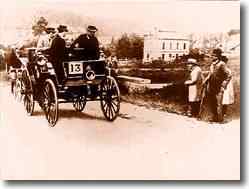
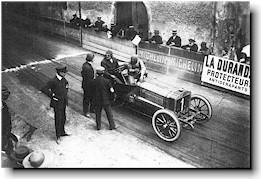
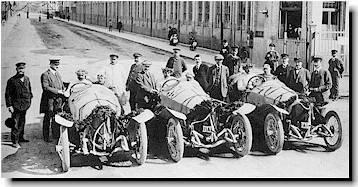
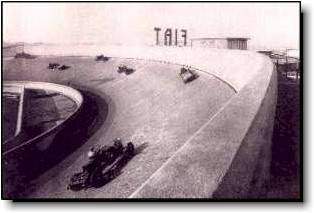 The
1920s saw the advent of shorter specially built circuits throughout
Europe. In 1922 the Italian Grand Prix was held at one of these new
tracks, the
The
1920s saw the advent of shorter specially built circuits throughout
Europe. In 1922 the Italian Grand Prix was held at one of these new
tracks, the 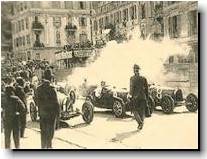
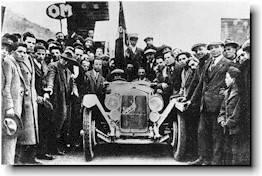 Due
to the amount of entrants the works teams would depart sometime the next
morning. Each car would have its starting time painted on the car, which
would allow spectators some indication of their relative placement.
Due
to the amount of entrants the works teams would depart sometime the next
morning. Each car would have its starting time painted on the car, which
would allow spectators some indication of their relative placement.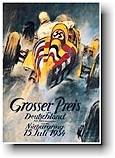 The
race length of a Grand Prix was a minimum 500 kilometer. Hitler's Germany
sponsored two teams to compete under this new formula,
The
race length of a Grand Prix was a minimum 500 kilometer. Hitler's Germany
sponsored two teams to compete under this new formula, 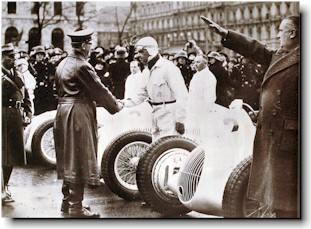
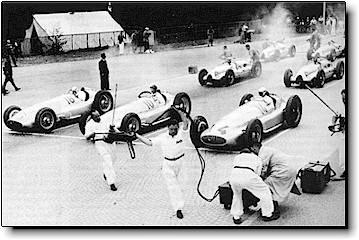 The
German cars were beginning to gain their stride. Later that year the Auto
Union of Hans Stuck would win the German and Swiss Grand Prix, while the
Mercedes of Caracciola won the Italian and Fagioli the Spanish.
The
German cars were beginning to gain their stride. Later that year the Auto
Union of Hans Stuck would win the German and Swiss Grand Prix, while the
Mercedes of Caracciola won the Italian and Fagioli the Spanish. 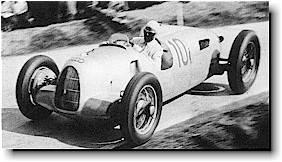 Astounding
not so much for its size to horsepower ration but the fact that they were
able to fit an engine of this size and power into a 750kg formula car.
Rosemeyer won German, Italian and Swiss Grands Prix along with the
Eifelrennen and the Coppa Acerbo. Mercedes in fact withdrew from racing in
order to develop their counter-attack. Their independent racing department
established in 1935 and under the direction of 30-year-old engineer Rudolf
Uhlenhaut was given a fresh infusion of the best Mercedes engineers and
ordered to develop a brand new car. In 1937 Mercedes created a W125
along with a reworked W25, both of them producing nearly 600 bhp, top
speeds reaching 200mph and wheel spin in every gear. The performance of
the W125 was unmatched by any other manufacturer, in fact it would not be
until the Can-Am cars of the late 1960s that another race car would equal
the horsepower of the 1937 Mercedes Grand Prix car.
Astounding
not so much for its size to horsepower ration but the fact that they were
able to fit an engine of this size and power into a 750kg formula car.
Rosemeyer won German, Italian and Swiss Grands Prix along with the
Eifelrennen and the Coppa Acerbo. Mercedes in fact withdrew from racing in
order to develop their counter-attack. Their independent racing department
established in 1935 and under the direction of 30-year-old engineer Rudolf
Uhlenhaut was given a fresh infusion of the best Mercedes engineers and
ordered to develop a brand new car. In 1937 Mercedes created a W125
along with a reworked W25, both of them producing nearly 600 bhp, top
speeds reaching 200mph and wheel spin in every gear. The performance of
the W125 was unmatched by any other manufacturer, in fact it would not be
until the Can-Am cars of the late 1960s that another race car would equal
the horsepower of the 1937 Mercedes Grand Prix car. 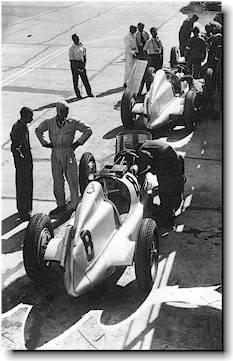 The
Avusrennen that year was run on a modified circuit. Reputedly at the
suggestion of Adolf Hitler, the North Curve was rebuilt and steeply banked
allowing for much higher speeds. The German cars ran with special
streamlined bodies. Hermann Lang's victory driving a Mercedes at an
average speed of 162.61 mph was not bested until A.J. Foyt averaged
164.173, while winning the Indianapolis 500 in 1967. As a final
exclamation point to these great machines, on January 28, Rudolf
Caracciola set a new class record in a 12-cylinder car with special
enclosed streamlined body. It set a top speed of 436.9 km/h during a
one-kilometer run in one direction with a flying start. This is the
highest speed ever driven on an ordinary road.
The
Avusrennen that year was run on a modified circuit. Reputedly at the
suggestion of Adolf Hitler, the North Curve was rebuilt and steeply banked
allowing for much higher speeds. The German cars ran with special
streamlined bodies. Hermann Lang's victory driving a Mercedes at an
average speed of 162.61 mph was not bested until A.J. Foyt averaged
164.173, while winning the Indianapolis 500 in 1967. As a final
exclamation point to these great machines, on January 28, Rudolf
Caracciola set a new class record in a 12-cylinder car with special
enclosed streamlined body. It set a top speed of 436.9 km/h during a
one-kilometer run in one direction with a flying start. This is the
highest speed ever driven on an ordinary road. 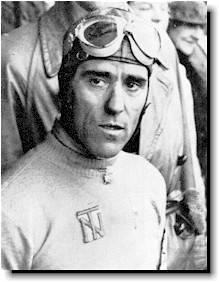 Leading
the race at the half way point his open Cisitalia sports car developed
electrical problems when it started to rain heavily. After lengthy repairs
he rejoined the race and worked his way back to the front but had to
settle for second place Already suffering from ill health he entered the
grueling race again the following year. Driving a new sports car from
Ferrari he soon found himself where he belonged, in the lead. Though
Nuvolari was very sick, coughing and spitting blood he was still able to
open an incredible 29-minute lead over his own teammate! Driving in
the only manner that he knew, flat out on the edge, he left parts of his
car all along the Italian countryside. Whether it was the manner in which
his car was built or his driving style, the Ferrari slowly came apart.
Soon the driver's seat came loose and was shortly replaced with a sack of
oranges and still he drove on. Knowing that he was dying and that this
might be his last chance for a victory he would not quit.
Leading
the race at the half way point his open Cisitalia sports car developed
electrical problems when it started to rain heavily. After lengthy repairs
he rejoined the race and worked his way back to the front but had to
settle for second place Already suffering from ill health he entered the
grueling race again the following year. Driving a new sports car from
Ferrari he soon found himself where he belonged, in the lead. Though
Nuvolari was very sick, coughing and spitting blood he was still able to
open an incredible 29-minute lead over his own teammate! Driving in
the only manner that he knew, flat out on the edge, he left parts of his
car all along the Italian countryside. Whether it was the manner in which
his car was built or his driving style, the Ferrari slowly came apart.
Soon the driver's seat came loose and was shortly replaced with a sack of
oranges and still he drove on. Knowing that he was dying and that this
might be his last chance for a victory he would not quit. 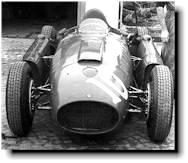 scored several victories including the opener in Argentina and the German
Grand Prix at the
scored several victories including the opener in Argentina and the German
Grand Prix at the 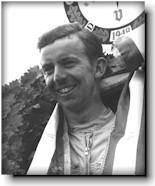 Brooks
and Stuart Lewis-Evans; two BRMs and three Coopers; one of them driven by
Jack Brabham. Moss streaked into the lead and drew steadily away from the
others only to suffer from engine problems. Seemingly done for the day on
lap 26, He took over the car of Brooks who was in ninth place. A
remarkable series of failures struck the leaders including a broken
clutch, engine failure, a tire puncture, and finally a broken throttle
linkage clearing the way for Moss to regain the lead! When Moss crossed
the line the crowd erupted in patriotic celebrations - a British car had
won the British Grand Prix with one of its sons.
Brooks
and Stuart Lewis-Evans; two BRMs and three Coopers; one of them driven by
Jack Brabham. Moss streaked into the lead and drew steadily away from the
others only to suffer from engine problems. Seemingly done for the day on
lap 26, He took over the car of Brooks who was in ninth place. A
remarkable series of failures struck the leaders including a broken
clutch, engine failure, a tire puncture, and finally a broken throttle
linkage clearing the way for Moss to regain the lead! When Moss crossed
the line the crowd erupted in patriotic celebrations - a British car had
won the British Grand Prix with one of its sons.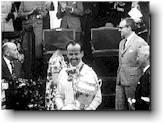 This
would require some modification to the engines and Vanwall would not be
able to complete these changes in time for the opening race in Argentina.
The Grand Prix of Argentina was noteworthy as Moss, driving a Cooper, used
one less pitstop and had to conserve his tires in the later stages of the
race, just crossing the line with the canvas showing. The next race,
This
would require some modification to the engines and Vanwall would not be
able to complete these changes in time for the opening race in Argentina.
The Grand Prix of Argentina was noteworthy as Moss, driving a Cooper, used
one less pitstop and had to conserve his tires in the later stages of the
race, just crossing the line with the canvas showing. The next race, 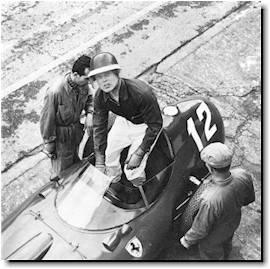 Peter
Collins had pledged at the beginning of the season that he would support
his friend, Hawthorn, in his pursuit of the title.
Peter
Collins had pledged at the beginning of the season that he would support
his friend, Hawthorn, in his pursuit of the title. 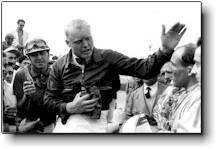
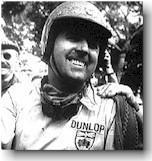 The
year was 1959 and the Grand Prix paddock was a very a different place.
Gone were
The
year was 1959 and the Grand Prix paddock was a very a different place.
Gone were 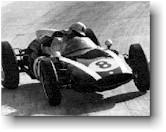 The
only chance that Moss would have for the title would be to win the race
and after qualifying on the pole he was doing just that. Unfortunately his
engine would not uphold its part of the bargain. This left the door open
for Brabham who promptly ran out of fuel. Stubbornly pushing his car over
the finish line he was awarded fourth place and the title. The victory
went to the youngest driver in history to win a Grand Prix, the 22 year
old New Zealander Bruce McLaren. Cooper won the Constructor's Cup beating
Ferrari by eight points. David had beaten Goliath and Grand Prix racing
would never be the same again.
The
only chance that Moss would have for the title would be to win the race
and after qualifying on the pole he was doing just that. Unfortunately his
engine would not uphold its part of the bargain. This left the door open
for Brabham who promptly ran out of fuel. Stubbornly pushing his car over
the finish line he was awarded fourth place and the title. The victory
went to the youngest driver in history to win a Grand Prix, the 22 year
old New Zealander Bruce McLaren. Cooper won the Constructor's Cup beating
Ferrari by eight points. David had beaten Goliath and Grand Prix racing
would never be the same again.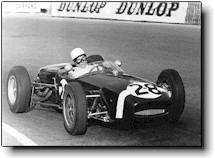
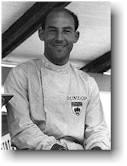 Normally
Stirling would never have attempted to pass anyone there, and as he
overtook me he was already off the grass. Then, for no apparent reason, he
just ploughed straight on into the bank. When he passed me he seemed to be
completely out of control. Just what happened no-one will ever know - but
I'm absolutely sure it wasn't due to driver error." Moss hovered near
death and when he finally awoke he was temporally paralyzed. On 1 May
1963, just over a year after his accident he returned to a deserted
Goodwood and tested a race car. Even though he was able to lap the circuit
at near racing speeds he found the effort extremely difficult. What had
been natural was no longer and he shortly afterwards announced his
retirement. The link to the past had been broken and a new generation
would rise to the top. Their names were
Normally
Stirling would never have attempted to pass anyone there, and as he
overtook me he was already off the grass. Then, for no apparent reason, he
just ploughed straight on into the bank. When he passed me he seemed to be
completely out of control. Just what happened no-one will ever know - but
I'm absolutely sure it wasn't due to driver error." Moss hovered near
death and when he finally awoke he was temporally paralyzed. On 1 May
1963, just over a year after his accident he returned to a deserted
Goodwood and tested a race car. Even though he was able to lap the circuit
at near racing speeds he found the effort extremely difficult. What had
been natural was no longer and he shortly afterwards announced his
retirement. The link to the past had been broken and a new generation
would rise to the top. Their names were 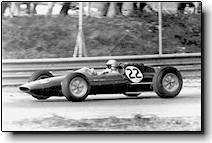 As
is their wont at Ferrari their 1962 season suffered due to internal
politics that exploded into a major rebellion at the factory that saw a
mass walkout of engineers and technical staff including their chief
engineer and team manager. The 1962 season would be fought with reworked
1961 cars driven chiefly by Phil Hill and supported by Willy Mairesse,
Ricardo Rodriguez, Giancarlo Baghetti and Lorenzo Bandini in the face of a
strengthened British and German challenge. The German challenge was not in
the form of either Mercedes or Auto Union but Porsche. Using a flat eight
air-cooled engine which was mounted to a much improved tubular chassis
they were ably driven by American Dan Gurney and popular Swedish driver Jo
Bonnier. At Lotus Innes Ireland was unceremoniously replaced with Trevor
Taylor to partner Colin's "new boy" Jimmy Clark. To match his
new star Chapman created the Type 25 using a monocoque chassis which
resulted in the driver siting in an almost bathtub like structure. This
type of construction allowed for increased rigidity and reduced weight,
two of the most important aspects in chassis design. BRM had Graham Hill
and Richie Ginther as numbers 1 and 2 respectively while Cooper had Bruce
McLaren and Tony Maggs. Brabham, who had left Cooper, was busily preparing
his own cars that would debut later in the season.
As
is their wont at Ferrari their 1962 season suffered due to internal
politics that exploded into a major rebellion at the factory that saw a
mass walkout of engineers and technical staff including their chief
engineer and team manager. The 1962 season would be fought with reworked
1961 cars driven chiefly by Phil Hill and supported by Willy Mairesse,
Ricardo Rodriguez, Giancarlo Baghetti and Lorenzo Bandini in the face of a
strengthened British and German challenge. The German challenge was not in
the form of either Mercedes or Auto Union but Porsche. Using a flat eight
air-cooled engine which was mounted to a much improved tubular chassis
they were ably driven by American Dan Gurney and popular Swedish driver Jo
Bonnier. At Lotus Innes Ireland was unceremoniously replaced with Trevor
Taylor to partner Colin's "new boy" Jimmy Clark. To match his
new star Chapman created the Type 25 using a monocoque chassis which
resulted in the driver siting in an almost bathtub like structure. This
type of construction allowed for increased rigidity and reduced weight,
two of the most important aspects in chassis design. BRM had Graham Hill
and Richie Ginther as numbers 1 and 2 respectively while Cooper had Bruce
McLaren and Tony Maggs. Brabham, who had left Cooper, was busily preparing
his own cars that would debut later in the season. Ferrari
was forced to withdraw from the race and when all the leaders suffered
from mechanical trouble it was an opportunistic Dan Gurney who claimed a
maiden victory for himself and for Porsche. Next up was the British Grand
Prix held at Aintree. Ferrari was only able to enter one car which was
driven by Phil Hill but he was unable to climb higher than 9th place when
he was forced to retire with mechanical trouble. The crowd saw a race long
duel between Clark and ex-motorcycle champion John Surtees in a Lola. But
after losing second gear Surtees had to settle for second place. With his
second win of the season, Clark was now in a tie with Graham Hill for the
Championship.
Ferrari
was forced to withdraw from the race and when all the leaders suffered
from mechanical trouble it was an opportunistic Dan Gurney who claimed a
maiden victory for himself and for Porsche. Next up was the British Grand
Prix held at Aintree. Ferrari was only able to enter one car which was
driven by Phil Hill but he was unable to climb higher than 9th place when
he was forced to retire with mechanical trouble. The crowd saw a race long
duel between Clark and ex-motorcycle champion John Surtees in a Lola. But
after losing second gear Surtees had to settle for second place. With his
second win of the season, Clark was now in a tie with Graham Hill for the
Championship.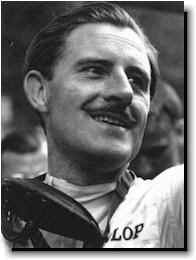 After
fifteen years and numerous setbacks that at times led to public ridicule,
the championship was in their grasp. Unfortunately for them nobody had
informed the Scotsman Clark that all was lost and after a convincing win
at the United States Grand Prix the title would be settled in South
Africa. Hill, who enjoyed a nine point lead on his rival had earned the
maximum points allowed based on his complete races but Clark could still
take the Championship on victories. And so it was that the failure of a 50
cent piece of hardware ended Clark's Championship hopes in East London and
gave the crown to Hill. Racing is all about skill mixed in with
preparation and a little bit of luck and no one begrudged the new Champion
on that day. At thirty-three, after six years of racing and only nine
years from receiving his first driver's license Graham Hill became
England's most popular champion. Starting as a mechanic earning 1£ a day
he reached racing's highest goal, Formula 1 World Champion.
After
fifteen years and numerous setbacks that at times led to public ridicule,
the championship was in their grasp. Unfortunately for them nobody had
informed the Scotsman Clark that all was lost and after a convincing win
at the United States Grand Prix the title would be settled in South
Africa. Hill, who enjoyed a nine point lead on his rival had earned the
maximum points allowed based on his complete races but Clark could still
take the Championship on victories. And so it was that the failure of a 50
cent piece of hardware ended Clark's Championship hopes in East London and
gave the crown to Hill. Racing is all about skill mixed in with
preparation and a little bit of luck and no one begrudged the new Champion
on that day. At thirty-three, after six years of racing and only nine
years from receiving his first driver's license Graham Hill became
England's most popular champion. Starting as a mechanic earning 1£ a day
he reached racing's highest goal, Formula 1 World Champion.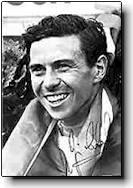 Jimmy
Clark coming so close to the championship in only his second full season
now knew what it would take to win the Championship and came to realize
that his time would come sooner rather than later. The Lotus 25 was
virtually unchanged from the previous year with attention paid to making
it more reliable. Its engine the Climax V8 was further refined to give it
increased driveability. They more than anyone else were eager for the new
season to start.
Jimmy
Clark coming so close to the championship in only his second full season
now knew what it would take to win the Championship and came to realize
that his time would come sooner rather than later. The Lotus 25 was
virtually unchanged from the previous year with attention paid to making
it more reliable. Its engine the Climax V8 was further refined to give it
increased driveability. They more than anyone else were eager for the new
season to start.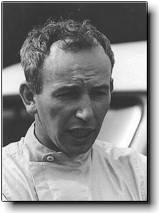 Until
Le Mans was over you couldn't really do the work you wanted to do-and
needed to do-in Formula One." The first race was again at Monaco
where Clark found himself on pole and shortly out of the race. Graham Hill
led his teammate Ginther for a BRM 1-2 finish while Clark won the next two
races at Zandvoort and Spa. The French Grand Prix saw Clark joined by
Surtees on the front row but the race was won by Dan Gurney now driving
for Brabham with Hill picking up second. The British Grand Prix had Clark
again on the pole but this time joined by Hill. They would finish the race
in the same order. Surtees felt that while his Ferrari was becoming more
and more competitive he could not let the duo of Clark and Hill get too
far out in front. Nurburgring would be his turning point. Returning to his
favorite circuit and the scene of his maiden victory scored only last
year, Surtees responded by capturing pole position. In the race Clark
jumped into the lead only to suffer mechanical problems that forced him to
retire. Surtees assumed a lead that he would not relinquish. Wining the
most difficult race on the calendar two years running proved that Surtees
belonged to the first rank of drivers during the early part of his career.
Until
Le Mans was over you couldn't really do the work you wanted to do-and
needed to do-in Formula One." The first race was again at Monaco
where Clark found himself on pole and shortly out of the race. Graham Hill
led his teammate Ginther for a BRM 1-2 finish while Clark won the next two
races at Zandvoort and Spa. The French Grand Prix saw Clark joined by
Surtees on the front row but the race was won by Dan Gurney now driving
for Brabham with Hill picking up second. The British Grand Prix had Clark
again on the pole but this time joined by Hill. They would finish the race
in the same order. Surtees felt that while his Ferrari was becoming more
and more competitive he could not let the duo of Clark and Hill get too
far out in front. Nurburgring would be his turning point. Returning to his
favorite circuit and the scene of his maiden victory scored only last
year, Surtees responded by capturing pole position. In the race Clark
jumped into the lead only to suffer mechanical problems that forced him to
retire. Surtees assumed a lead that he would not relinquish. Wining the
most difficult race on the calendar two years running proved that Surtees
belonged to the first rank of drivers during the early part of his career.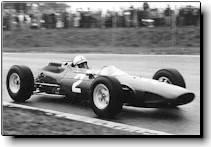 Things
tightened up when Hill won the next race at Watkins Glen and unlike last
year the title would be won or lost at the last race. The final race in
Mexico saw Hill leading with 39 points, Surtees with 34 points and Clark
with 30 points. At the start of the race Clark led off from his pole
position but both Hill and Surtees were slow off the mark and found
themselves 10th and 13th respectively. As the race progressed Hill was
able to move up to third with Surtees now in fifth. All Hill had to do was
stay out of trouble but unfortunately trouble was right behind him.
Bandini driving for all he was worth looked for any opportunity to pass
Hill and thought he had found it when Hill momentarily left the door open.
Bandini dove for the inside but too late, leaving Hill nowhere to go but
into the guardrail. Hill was able to return to the race but only after
losing two laps. After Clark retired with a seized engine it was Bandini
who allowed his teammate Surtees, to pass him into second place and the
World Championship. Surtees could now add a four-wheel title to his seven
two-wheel titles.
Things
tightened up when Hill won the next race at Watkins Glen and unlike last
year the title would be won or lost at the last race. The final race in
Mexico saw Hill leading with 39 points, Surtees with 34 points and Clark
with 30 points. At the start of the race Clark led off from his pole
position but both Hill and Surtees were slow off the mark and found
themselves 10th and 13th respectively. As the race progressed Hill was
able to move up to third with Surtees now in fifth. All Hill had to do was
stay out of trouble but unfortunately trouble was right behind him.
Bandini driving for all he was worth looked for any opportunity to pass
Hill and thought he had found it when Hill momentarily left the door open.
Bandini dove for the inside but too late, leaving Hill nowhere to go but
into the guardrail. Hill was able to return to the race but only after
losing two laps. After Clark retired with a seized engine it was Bandini
who allowed his teammate Surtees, to pass him into second place and the
World Championship. Surtees could now add a four-wheel title to his seven
two-wheel titles.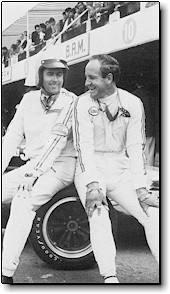 Ferrari
would have a new V12 while Lotus and BRM, left without an engine supplier
following Coventry's withdrawal, were forced to settle for modified Climax
and BRM V8 engines bored out to 2-liters respectively. Dan Gurney left
Brabham to his own team, All-American Racers. Brabham as usual going his
own way commissioned Repco, an Australian parts manufacturer, to produce a
new V8. Following the guidelines laid down by Brabham the engine was
sturdy, light and compact. To replace Gurney, Brabham promoted Denny Hulme
to number two.
Ferrari
would have a new V12 while Lotus and BRM, left without an engine supplier
following Coventry's withdrawal, were forced to settle for modified Climax
and BRM V8 engines bored out to 2-liters respectively. Dan Gurney left
Brabham to his own team, All-American Racers. Brabham as usual going his
own way commissioned Repco, an Australian parts manufacturer, to produce a
new V8. Following the guidelines laid down by Brabham the engine was
sturdy, light and compact. To replace Gurney, Brabham promoted Denny Hulme
to number two.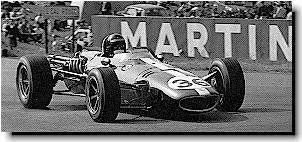
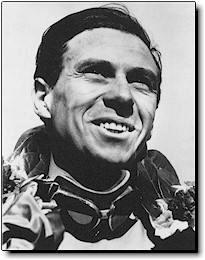 The
1968 season had barely begun before it was rocked to its very foundations
by the death of its biggest star,
The
1968 season had barely begun before it was rocked to its very foundations
by the death of its biggest star, 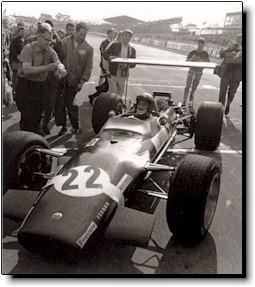
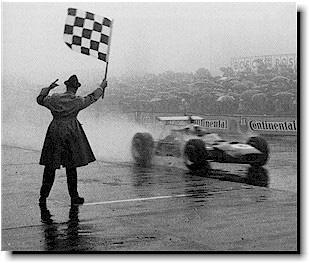 The
next race, the German Grand Prix was run under atrocious conditions with
many of the drivers reluctant to drive in such whether. No one more so
than Jackie Stewart who had to be ordered by Ken Tyrrell to start the
race. Ironically many would later consider this his greatest
race. Actually it was more like two races, The one that Stewart was
driving in and the one that contained all of the others. Nursing a broken
wrist suffered in a Formula Two race he started the race from the sixth
position. As soon as the flag dropped he began his charge to the front
reeling in the other cars and by the end of the first lap he was 8 seconds
clear. After the second lap he was more than 30 seconds in the lead.
Behind him Graham Hill and Chris Amon struggled to maintain this
blistering pace. Many of the other cars spun out including eventual second
place finisher Hill.
The
next race, the German Grand Prix was run under atrocious conditions with
many of the drivers reluctant to drive in such whether. No one more so
than Jackie Stewart who had to be ordered by Ken Tyrrell to start the
race. Ironically many would later consider this his greatest
race. Actually it was more like two races, The one that Stewart was
driving in and the one that contained all of the others. Nursing a broken
wrist suffered in a Formula Two race he started the race from the sixth
position. As soon as the flag dropped he began his charge to the front
reeling in the other cars and by the end of the first lap he was 8 seconds
clear. After the second lap he was more than 30 seconds in the lead.
Behind him Graham Hill and Chris Amon struggled to maintain this
blistering pace. Many of the other cars spun out including eventual second
place finisher Hill.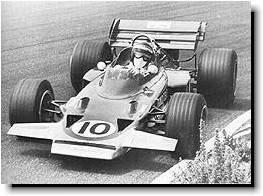 1970
was notable for the debut of a number of new talented drivers to Formula1
led by Ronnie Peterson this group would include Francois Cevert, Clay
Regazzoni, Henri Pescarolo and future World Champion Emerson Fittipaldi.
The year was also a tragic one that saw the deaths of Bruce Mclaren, Piers
Courage and almost unbelievably Jochen Rindt on the eve of his first World
Championship which was awarded to him posthumously. The other sensation of
1970 was the new
1970
was notable for the debut of a number of new talented drivers to Formula1
led by Ronnie Peterson this group would include Francois Cevert, Clay
Regazzoni, Henri Pescarolo and future World Champion Emerson Fittipaldi.
The year was also a tragic one that saw the deaths of Bruce Mclaren, Piers
Courage and almost unbelievably Jochen Rindt on the eve of his first World
Championship which was awarded to him posthumously. The other sensation of
1970 was the new 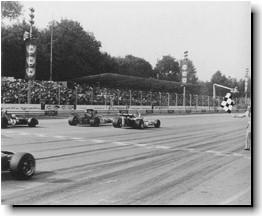 The
Italian Grand Prix at Monza witnessed the closest race in history. Its
hard to imagine these days but the Monza circuit used to play host to
tremendous slipstreaming duels of which 1971 was the greatest.
The
Italian Grand Prix at Monza witnessed the closest race in history. Its
hard to imagine these days but the Monza circuit used to play host to
tremendous slipstreaming duels of which 1971 was the greatest.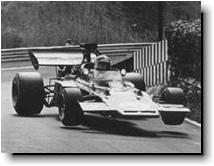 The
1972 season looked set to be a repeat of last year which was dominated by
Jackie Stewart and Tyrrell. Ferrari had the experienced Ickx ably joined
by Regazzoni and American Mario Andretti when his schedule would permit.
Lotus without Jochen Rindt and led by a young 25 year old Brazilian,
Emerson Fittipaldi was not thought to be a major challenger. Now called
John Player Specials after the cigarette brand, they were painted in a
stunning black and gold. Another major tobacco company, Phillip Morris
paid a large sum to BRM who would now be called Marlboro-BRM. Unlike the
gentleman drivers of the past the sport saw the rise of the paid driver
who would purchase his seat in a team with personal sponsorship
money.
The
1972 season looked set to be a repeat of last year which was dominated by
Jackie Stewart and Tyrrell. Ferrari had the experienced Ickx ably joined
by Regazzoni and American Mario Andretti when his schedule would permit.
Lotus without Jochen Rindt and led by a young 25 year old Brazilian,
Emerson Fittipaldi was not thought to be a major challenger. Now called
John Player Specials after the cigarette brand, they were painted in a
stunning black and gold. Another major tobacco company, Phillip Morris
paid a large sum to BRM who would now be called Marlboro-BRM. Unlike the
gentleman drivers of the past the sport saw the rise of the paid driver
who would purchase his seat in a team with personal sponsorship
money. 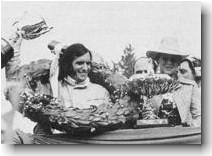 Stewart
was back for the next race, the French GP which he won after race leader
Chris Amon suffered a late race puncture. Fittipaldi came in second. The
order was reversed the following race in England with Fittipaldi leading
Stewart.
Stewart
was back for the next race, the French GP which he won after race leader
Chris Amon suffered a late race puncture. Fittipaldi came in second. The
order was reversed the following race in England with Fittipaldi leading
Stewart.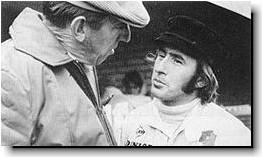 The
next race was the Swedish Grand Prix at Anderstorp and here Denis Hulme
brought the first victory for the new McLaren. Lotus won the next race in
France but this time it was Fittipaldi's teammate Peterson who took the
flag. The British Grand Prix after a re-start following a multi-car
pile-up was won by Hulme teammate, American Peter Revson. The Championship
had now seen five different winners but at Zandvoort the results saw
another Tyrrell 1-2 with Stewart winning a race marked by the death of
Englishman Roger Williamson. The Nurburgring saw the same Tyrrell 1-2 but
the sensation of the race was the record lap posted by Carlos Pace in a
Surtees. Pace repeated this feat in Austria which was won by Peterson.
Peter Revson scored his second and last win in Canada under adverse
weather conditions. There was some dispute amongst independent observers
on whether second place finisher Fittipaldi had actually won. The United
States Grand Prix was won by Ronnie Peterson but it was Stewart who
clinched his third and last World Championship. What should have been a
Tyrrell celebration was marred by the tragic death of Stewart teammate
Francois Cevert during practice. Stewart who had decided to retire
at the end of the season would not start the race which would have been
his last.
The
next race was the Swedish Grand Prix at Anderstorp and here Denis Hulme
brought the first victory for the new McLaren. Lotus won the next race in
France but this time it was Fittipaldi's teammate Peterson who took the
flag. The British Grand Prix after a re-start following a multi-car
pile-up was won by Hulme teammate, American Peter Revson. The Championship
had now seen five different winners but at Zandvoort the results saw
another Tyrrell 1-2 with Stewart winning a race marked by the death of
Englishman Roger Williamson. The Nurburgring saw the same Tyrrell 1-2 but
the sensation of the race was the record lap posted by Carlos Pace in a
Surtees. Pace repeated this feat in Austria which was won by Peterson.
Peter Revson scored his second and last win in Canada under adverse
weather conditions. There was some dispute amongst independent observers
on whether second place finisher Fittipaldi had actually won. The United
States Grand Prix was won by Ronnie Peterson but it was Stewart who
clinched his third and last World Championship. What should have been a
Tyrrell celebration was marred by the tragic death of Stewart teammate
Francois Cevert during practice. Stewart who had decided to retire
at the end of the season would not start the race which would have been
his last.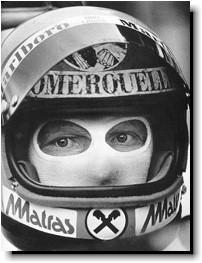 Lauda
would bring to Ferrari new blood and along with the promotion of a young
lawyer, Luca di Montezemolo, to head the F1 team Ferrari's fortunes would
take a turn for the better. Ironically it was Regazzoni who at first was
considered the leading driver. Lauda soon got down to work. After taking
up residence at the Canal Grande Hotel in Modena he spent endless days
testing and working with the engineers and mechanics to improve the
performance of the Ferrari 312B3. The chief rivals to Ferrari would be the
McLaren M23s of Emerson Fittipaldi and Denny Hulme, the Lotus of Ronnie
Peterson, the Brabham driven by Carlos Reutemann and the Tyrell of South
African Jody Scheckter. McLaren drew first blood in Argentina in the hand
of Denny Hulme. Moving to Brazil it was teammate Fittipaldi's turn as he
battled Ronnie Peterson before a puncture ended the Swedish driver's
challenge. Even though McLaren took the first two races it was evident to
all that the Ferraris of Regazzoni and Lauda would soon be heard from.
Meanwhile Brabham showed that they couldn't be counted out when Carlos
Reutemann won in South Africa. At Jarma, Spain Ferrari was back on top
with Niki Lauda taking the victory. Next in order came the Belgian Grand
Prix, this year run at Nivelles, which was claimed by Fittipaldi,
Monaco which went to Peterson and Sweden which was won by Scheckter. The
race for the Championship was now wide open but it was the dependability
of McLaren and Fittipaldi which would soon see them through. Lauda and
Regazzoni scored a strong 1-2 at the Dutch Grand Prix and Scheckter
returned to the winner's circle at Brands Hatch. Regazzoni was victorious
at the Nurburgring while Lauda was unable to finish the first lap when he
uncharacteristically made an error. Reutemann became a double winner at
the Österreichring ad Peterson did at Monza. The Championship moved to
North America and Fittipaldi became the first three time winner. The
title race was now a tie between Fittipaldi and Regazzoni but with fourth
place at Watkins Glen, the race being won by Reutemann, the Brazilian
became a two time World Champion as Regazzoni could not keep pace due to
mechanical problems. McLaren also won the Constructors Championship but
Ferrari served notice that they would be a potent force in the years to
come.
Lauda
would bring to Ferrari new blood and along with the promotion of a young
lawyer, Luca di Montezemolo, to head the F1 team Ferrari's fortunes would
take a turn for the better. Ironically it was Regazzoni who at first was
considered the leading driver. Lauda soon got down to work. After taking
up residence at the Canal Grande Hotel in Modena he spent endless days
testing and working with the engineers and mechanics to improve the
performance of the Ferrari 312B3. The chief rivals to Ferrari would be the
McLaren M23s of Emerson Fittipaldi and Denny Hulme, the Lotus of Ronnie
Peterson, the Brabham driven by Carlos Reutemann and the Tyrell of South
African Jody Scheckter. McLaren drew first blood in Argentina in the hand
of Denny Hulme. Moving to Brazil it was teammate Fittipaldi's turn as he
battled Ronnie Peterson before a puncture ended the Swedish driver's
challenge. Even though McLaren took the first two races it was evident to
all that the Ferraris of Regazzoni and Lauda would soon be heard from.
Meanwhile Brabham showed that they couldn't be counted out when Carlos
Reutemann won in South Africa. At Jarma, Spain Ferrari was back on top
with Niki Lauda taking the victory. Next in order came the Belgian Grand
Prix, this year run at Nivelles, which was claimed by Fittipaldi,
Monaco which went to Peterson and Sweden which was won by Scheckter. The
race for the Championship was now wide open but it was the dependability
of McLaren and Fittipaldi which would soon see them through. Lauda and
Regazzoni scored a strong 1-2 at the Dutch Grand Prix and Scheckter
returned to the winner's circle at Brands Hatch. Regazzoni was victorious
at the Nurburgring while Lauda was unable to finish the first lap when he
uncharacteristically made an error. Reutemann became a double winner at
the Österreichring ad Peterson did at Monza. The Championship moved to
North America and Fittipaldi became the first three time winner. The
title race was now a tie between Fittipaldi and Regazzoni but with fourth
place at Watkins Glen, the race being won by Reutemann, the Brazilian
became a two time World Champion as Regazzoni could not keep pace due to
mechanical problems. McLaren also won the Constructors Championship but
Ferrari served notice that they would be a potent force in the years to
come.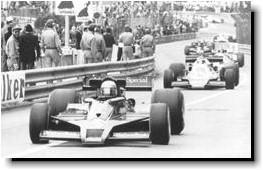 Two
major developments occurred during 1977, the Renault turbo made its debut
at the British Grand Prix while the Lotus-Ford 78 debuted in Argentina.
Both would effect racing for years to come. The Lotus was the first
successful implementation of "ground effects" - the ability to
harness the air that travels under the car. The idea had its origins in
Land Speed Record cars back in the 30's, specifically the
Two
major developments occurred during 1977, the Renault turbo made its debut
at the British Grand Prix while the Lotus-Ford 78 debuted in Argentina.
Both would effect racing for years to come. The Lotus was the first
successful implementation of "ground effects" - the ability to
harness the air that travels under the car. The idea had its origins in
Land Speed Record cars back in the 30's, specifically the 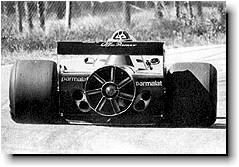 Mario
Andretti had won 4 races in 1977 but reliability problems doomed his
championship chances but in 1978 he would complete his boyhood dream and
win the World Championship. For 1978 Andretti was joined by Ronnie
Peterson at Lotus replacing Gunnar Nilsson who was suffering from cancer
that would soon take his life. Peterson joined Lotus in a supporting role
hoping to restore his career after a disastrous time with Tyrrell. For
1978 Lotus was now using the new 79 with modified side pods that could be
changed according to track conditions. In all Lotus won eight of the
sixteen races that year with six going to Andretti and two going to
Peterson.
Mario
Andretti had won 4 races in 1977 but reliability problems doomed his
championship chances but in 1978 he would complete his boyhood dream and
win the World Championship. For 1978 Andretti was joined by Ronnie
Peterson at Lotus replacing Gunnar Nilsson who was suffering from cancer
that would soon take his life. Peterson joined Lotus in a supporting role
hoping to restore his career after a disastrous time with Tyrrell. For
1978 Lotus was now using the new 79 with modified side pods that could be
changed according to track conditions. In all Lotus won eight of the
sixteen races that year with six going to Andretti and two going to
Peterson.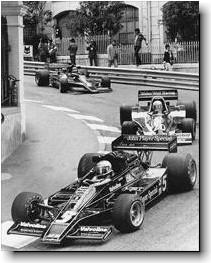 Lotus
came out with the Type 80 but the car was a disaster, forcing them to
revert to last years Type 79. As had been their recent record this would
be a down year for Lotus and the beginning of a general downward trend for
the famous British team. The new Williams FW07 driven by Alan Jones and
Clay Regazzoni would prove the rightful heir to the
Lotus
came out with the Type 80 but the car was a disaster, forcing them to
revert to last years Type 79. As had been their recent record this would
be a down year for Lotus and the beginning of a general downward trend for
the famous British team. The new Williams FW07 driven by Alan Jones and
Clay Regazzoni would prove the rightful heir to the 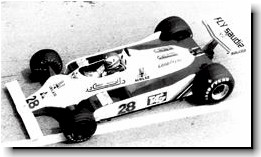 The
fast track at Silverstone was next and the Williams would dominate the
Grand Prix as they and Ferrari would battle the remainder of
the season for the title. In the end it was Ferrari's reliability that
would prove tough to beat as Scheckter would claim the title from his
teammate Villeneuve with Alan Jones third.
The
fast track at Silverstone was next and the Williams would dominate the
Grand Prix as they and Ferrari would battle the remainder of
the season for the title. In the end it was Ferrari's reliability that
would prove tough to beat as Scheckter would claim the title from his
teammate Villeneuve with Alan Jones third.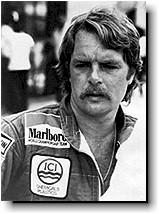 By
1981 Ferrari was now firmly in the turbo camp but even the talents of
Gilles Villeneuve couldn't carry the ill-handling car to the championship.
McLaren was now under the control of Ron Dennis and with John Watson
driving a John Barnard designed McLaren MP4 it became the first carbon-fibre
chassis car to win a championship race at the British Grand Prix. The
title came down to the final race in Las Vegas and Piquet with a fifth
place finish secured enough points to become World Champion. Turbo powered
cars continued to make progress and when the year was over they had won
seven of the 16 races on that years calendar.
By
1981 Ferrari was now firmly in the turbo camp but even the talents of
Gilles Villeneuve couldn't carry the ill-handling car to the championship.
McLaren was now under the control of Ron Dennis and with John Watson
driving a John Barnard designed McLaren MP4 it became the first carbon-fibre
chassis car to win a championship race at the British Grand Prix. The
title came down to the final race in Las Vegas and Piquet with a fifth
place finish secured enough points to become World Champion. Turbo powered
cars continued to make progress and when the year was over they had won
seven of the 16 races on that years calendar. 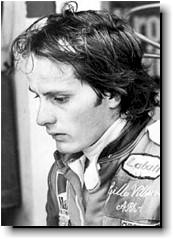
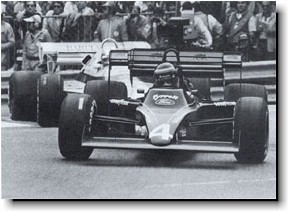 It
was 1984 and turbo-charged engines were soon to be used by all of the
teams save Tyrrell which soldiered on with the normally-aspirated Cosworth-Ford.
Fuel consumption was restricted to 220 liters with refueling stops no
longer allowed. Mandated by a desire to reduce overall speeds these rules
had the negative impact of turning many of the races into "economy
runs". Radial tires became standard equipment for both wet and dry
tires.
It
was 1984 and turbo-charged engines were soon to be used by all of the
teams save Tyrrell which soldiered on with the normally-aspirated Cosworth-Ford.
Fuel consumption was restricted to 220 liters with refueling stops no
longer allowed. Mandated by a desire to reduce overall speeds these rules
had the negative impact of turning many of the races into "economy
runs". Radial tires became standard equipment for both wet and dry
tires. 
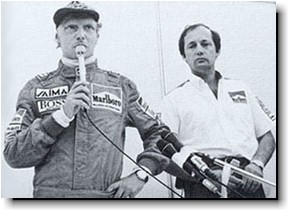 For the Canadian Grand Prix the first four places were held by Lotus and
Ferrari.
For the Canadian Grand Prix the first four places were held by Lotus and
Ferrari.