|
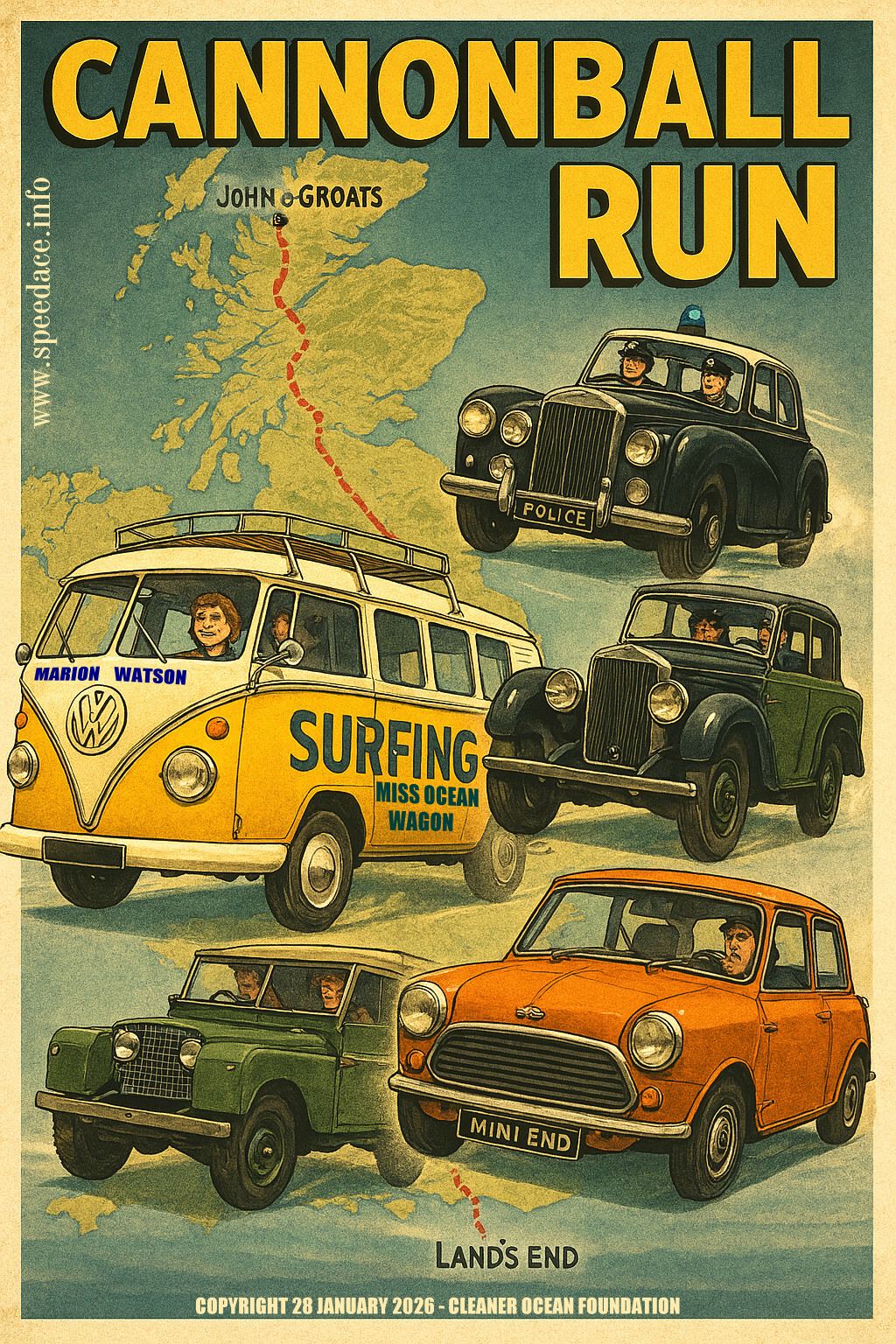
MARION
WATSON
- The family enter a historic vehicle run, from John O'Groats to Land's End.
"Low-Tide" (Real name: Barnaby "Barney" Blythe). Operating a fish-delivery truck, Barney
knows exactly where the sea spray made the roads slick and where the "Smokey Bears"
like to hide behind hedges.
''Low
Tide" works with:
"Pasty Pilot" (Real name: Arthur "Artie"
Penhaligon),
drives a massive refrigerated lorry full of frozen savories, Artie had the best high-ground view of the
moor at Bodmin.
"Tin-Man" (Real name: Silas Rowe).
Is a veteran haulier moving heavy machinery, Silas knows every "rat-run" and back lane in the mining
district.
CANNONBALL
RUN CAST
|
PROTAGONISTS |
- |
DESCRIPTION |
|
- |
- |
- |
|
Anthony
Maximus Antonious Decimus Meridius |
- |
The
DinoBot hexapod AI, modern autonomous gladiator |
|
Arthur
King |
- |
Senior
cabinet member of Cornwall
County Council |
|
Charley
Temple |
- |
An investigative
reporter, surfing and watersports fan |
|
Google
Maps |
- |
Computer
and smartphone maps and route planning software |
|
Jill
Bird |
- |
BBC
world news anchor, long time friend of Charley
Temple |
|
Jimmy
Watson |
- |
AI
computer programming
boy genius |
|
Low
Tide |
- |
Trucker:
Barnaby (Barney) Blythe, Cannonballer's friend |
|
Marion
Watson |
- |
Surfing
champion, now retired Mum, artist & coach |
|
Miss
Ocean |
- |
Marion
Watson's cherished
VW
surfing
bus, tour wagon |
|
Pasty
Pete |
- |
Trucker:
Arthur (Artie) Penhaligon, Cannonballer's friend |
|
Ryan
(Roadworthy) Reynolds |
- |
The
RAC mechanic who thinks Miss Ocean is
alive |
|
Scottish
Councils |
- |
Scotland's
Highlands and Lowlands |
|
Solar
Cola |
- |
Marion's
favourite drink
when surfing
or competing |
|
Timothy
Watson |
- |
British
(MI6)
Army General, stationed in Germany |
|
Tin
Man |
- |
Trucker:
Silas Rowe, Cannonballer's friend |
|
TomTom |
- |
Route
planning, directions & road navigation
maps for vehicle drivers |
|
- |
- |
- |
|
CHARACTERS:
ANTAGONISTS |
- |
DESCRIPTION |
|
|
- |
|
|
Baron
Butler-Farquhar |
- |
Dastardly
character, driver Rolls
Royce Phantom |
|
Basher
Blackadder |
- |
British
Army batman, co- driver of a Land Rover series 1 |
|
Basil
Rathbone |
- |
Metropolitan
Police Inspector, Scotland
Yard, London
to Brighton |
|
General
Gerard (Gearstick) Montgomery |
- |
By
the numbers military man, driver of a Land Rover series 1 |
|
Nikolia
Novak |
- |
Clothing
millionaire, driving a E-Type
Jaguar |
|
Percy
(Potty) Parker |
- |
The
Baron's opinionated navigator (chauffer), Rolls Royce Phantom |
|
Poppy
Powers |
- |
One
of the glitters girls, cosmetics millionaires,
Mini Cooper driver |
|
Ruby
Redlips |
- |
One
of the glitters girls, cosmetics millionaires, Mini Cooper navigator |
|
Sergeant
(Mitch) Miller |
- |
Metropolitan
Police officer works for Insp. Rathbone at Scotland Yard |
|
Winston
Whalberg |
- |
Bentley
blower driver, former fine art dealer |
Truckers
who love the road, and driving would naturally work against Basil
Rathbone at Scotland Yard in
London,
and Sergeant Miller, the hands on police presence, if they try to impede
the lawful progress of competitors. And here is why:
In a classic case of
inter-group conflict—a psychological "us versus them" dynamic that has been fueling the highway rivalry for decades. When you look at the life of a long-haul trucker, you see a profession that is high-stress, isolated, and governed by a clock that never stops.
To understand why this tension exists, we have to look at the psychological landscape of the road, the history of the "Smokey Bear" persona, and the fundamental clash in how each group views its mission.
1. The Psychology of the "Rolling Office"
For a trucker, the cab isn't just a seat; it’s their home, office, and sanctuary. Psychologically, when an officer pulls over a rig, they aren't just stopping a vehicle—they are "invading" a private space.
- Autonomy vs. Authority: Truckers value independence. The nature of the job attracts "lone wolves" who enjoy self-reliance. Constant monitoring via Electronic Logging Devices (ELDs) and roadside inspections feels like a direct assault on that autonomy.
- The "Tax Collector" Perception: Many drivers feel that law enforcement sees them as "mobile ATMs." Because a commercial ticket is significantly more expensive than a civilian one, the psychological friction is rooted in a feeling of being targeted for revenue rather than safety.
2. The CB Radio: A Digital Brotherhood
The CB radio was the first "social network." It served a vital psychological function: Social Validation.
- Anonymity and Protection: Terms like "Smokey Bear" (referring to the hats worn by state troopers, resembling the fire safety icon) allowed truckers to alert one another without fear of immediate repercussion.
- Cognitive Dissonance: Responsible truckers take immense pride in their safety records. When they are treated with the same suspicion as "cowboy" hauliers (those who skip maintenance or falsify logs), it creates a sense of injustice. Warning others of a "bear in the bushes" is a way of "protecting the tribe" from what they perceive as unfair harassment.
3. The "Smokey" Perspective
From the other side of the badge, the psychology is different. Police officers often view their role through the lens of Public Risk Management. * The Weight of Responsibility: An 80,000-pound vehicle is a potential catastrophe if a driver is fatigued or the brakes fail. Officers are trained to look for "red flags" because the stakes are so high.
Dehumanization: Just as truckers feel like "just a number" to the DOT, officers often feel dehumanized by the "Smokey" label. They see themselves as the thin line keeping the roads safe, yet they are greeted with hostility by the very people they are policing.
Ultimately, the friction stems from a lack of shared identity. While both groups are essentially "working the road," their incentives are diametrically opposed: one is paid to move, and the other is paid to make sure everyone is following the rules that slow them down.
THE SHIFT FROM CB'S TO MODERN TECHNOLOGY
The shift from the "Golden Age" of CB radios to today’s digital landscape has fundamentally rewritten the psychological contract between truckers and the law. While technology has made the roads safer and
navigation more precise, it has also dismantled much of the "outlaw" camaraderie that once defined the profession.
Here is how the dynamic has evolved:
1. From "Tribal Knowledge" to "Data Crowdsourcing"
In the 70s and 80s, the CB was a local, real-time "shield." If you missed a "smokey" report because your squelch was too high or you were on the wrong channel, you were on your own.
The CB Era (The Human Shield): Warning others was a social act. You had to "break" the channel, use your handle, and engage with others. It reinforced a sense of brotherhood against a common "enemy."
The App Era (The Passive Shield): Apps like Waze and Trucker Path have automated this. A driver doesn't even have to speak; they just tap a screen to mark a "Police" icon. This has turned a social act into a transactional one. While it's more accurate, it’s less personal, contributing to the loneliness many modern drivers report.
2. The ELD: The "Spy in the Cab"
The Electronic Logging Device (ELD) is perhaps the most significant psychological disruptor in the history of trucking.
Loss of Flexibility: Before ELDs, "Responsible" truckers could use a bit of "paper-log magic" to find a safe parking spot if they ran out of hours five miles from a rest stop. Now, the clock is absolute.
The Stress of the Countdown: Drivers now feel a "digital whip" at their backs. Psychologically, this makes interactions with police or DOT
(Department of Transport) inspectors even more volatile. A 20-minute roadside inspection isn't just a delay; it can legally force a driver to stop for 10 hours just a few miles from their home or delivery point. This fuels the "persecution" feeling you mentioned—the sense that the law is literally preventing them from doing their job.
3. The End of the "Grey Area"
The "Them vs. Us" mentality used to exist in a grey area where drivers could "outsmart" the bears. Modern tech has closed those gaps.
Infrastructure vs. Instinct: Smart weigh stations (PrePass) and weigh-in-motion sensors mean that police often know if a truck is overweight or has an expired permit before the driver even sees the
"Chicken Coop."
Information Asymmetry: In the past, the trucker usually had more "road intel" than the officer thanks to the CB. Today, the police have the data advantage. This shift in power has turned the
"cat and mouse" game into a "system vs. user" dynamic, which can feel much more dehumanizing for the driver.
4. The Digital Brotherhood
It's not all negative. While the CB has faded to "Sesame Street" (mostly static and nonsense) in many areas, the brotherhood has moved online:
WhatsApp & Discord Groups: Small fleets and groups of friends now have private digital channels. This allows for "clean" communication without the "Smokey" listening in (as police often did with CBs).
Social Media Accountability: Truckers now use smartphones to film "bad" police interactions or "illegal hauliers." This has given responsible truckers a tool for public relations, helping to combat the "persecuted" feeling by showing the world the reality of their "rolling office."
The "Smokey Bear" hasn't gone away, but they have traded their binoculars for a tablet. For the trucker, the road has become less of a "wild frontier" and more of a "monitored corridor."
THE CANNONBALL RUN
The "Great British Cannonball Run" serves as the perfect stage for this psychological drama! In this fictional world, the trucker becomes the unsung hero—the "Gandalf" of the motorway—guiding the sleek, fast cars through the treacherous terrain of speed cameras and Average Speed Checks.
Why would a trucker, hauling 40 tons of frozen peas, help a billionaire in a
Lamborghini? It’s not about the cars; it’s about the principle.
1. "The Enemy of My Enemy is My Friend"
In the mind of a driver who feels "badgered" by the police, anyone pushing back against the "system" is an ally. If the police are occupied trying to catch a brightly colored
Ferrari, they aren't looking at the trucker’s tacho or checking his tyre depth.
Evening the Score: Helping a Cannonballer is a way for truckers to "win" by proxy. They can’t go 160
mph, but they can ensure someone else does (safely), effectively poking a finger in the eye of the "police state" they feel oppressed by.
2. The Romanticism of the Road
Truckers are, at heart, the last of the nomads. They often view modern road policing (ANPR cameras, smart motorways) as the death of the "Spirit of the Road."
The Tourist vs. The Target: From the trucker's perspective, a Cannonball Run is a celebration of driving. When the police move to "quash" it, the trucker sees it as further proof that fun and freedom are being regulated out of existence. By blocking a lane to let a competitor pass, or "dropping the hammer" to create a screen, they are protecting a dying culture of adventure.
3. The "Safety Escort" Logic
You make a provocative point: Should the police be helping? In a fictional, idealistic world, the argument for police cooperation would look like this:
- Controlled Chaos: If the police worked with the event, they could ensure participants stayed within safe (if high) limits, perhaps even clearing traffic to prevent the "accordion effect" that causes accidents.
- Psychological Shift: If the police acted as "Marshals" rather than "Hunters," the "us vs. them" wall would crumble.
- The Irony: The "Smokey Bear" psychology is built on deterrence. If they helped the Cannonballers, they would be admitting that the road belongs to the drivers, not the regulators. To the police, an unsanctioned run is "dangerous" by definition because they aren't in control of it.
WHY THE TRUCKER "INTERVENES" (Fictionally)
Imagine a scenario on the M6: A Cannonballer is flying toward a hidden mobile speed van. A trucker, seeing this on his "private" digital channel, pulls out slightly to obscure the camera's line of sight or flashes his hazard lights in a specific pattern.
The Motivation: It's "The Robin Hood Effect." The trucker sees the Cannonballer as a rogue hero and the police as the Sheriff of Nottingham.
It’s about reclaiming the road as a place of human interaction and skill, rather than just a monitored "conveyor belt" for commerce. In the trucker's eyes, if the Cannonballer is a "professional" enthusiast who isn't weaving through traffic like a maniac, they deserve the protection of the "Big Brothers" of the road.
In
the end, the police take a shine to the
Volkswagen
T2 surfing
wagon, and the truly sportsmanlike conduct of the Watson family and
the other competitors, with the exception of Baron Farquhar. But even he
has a change of heart, and gets away with just a few speeding tickets and
other traffic violations, a reformed character.
|